
Heater Blowing Cold Air? A Technician's Diagnostic Guide
Written by Cody
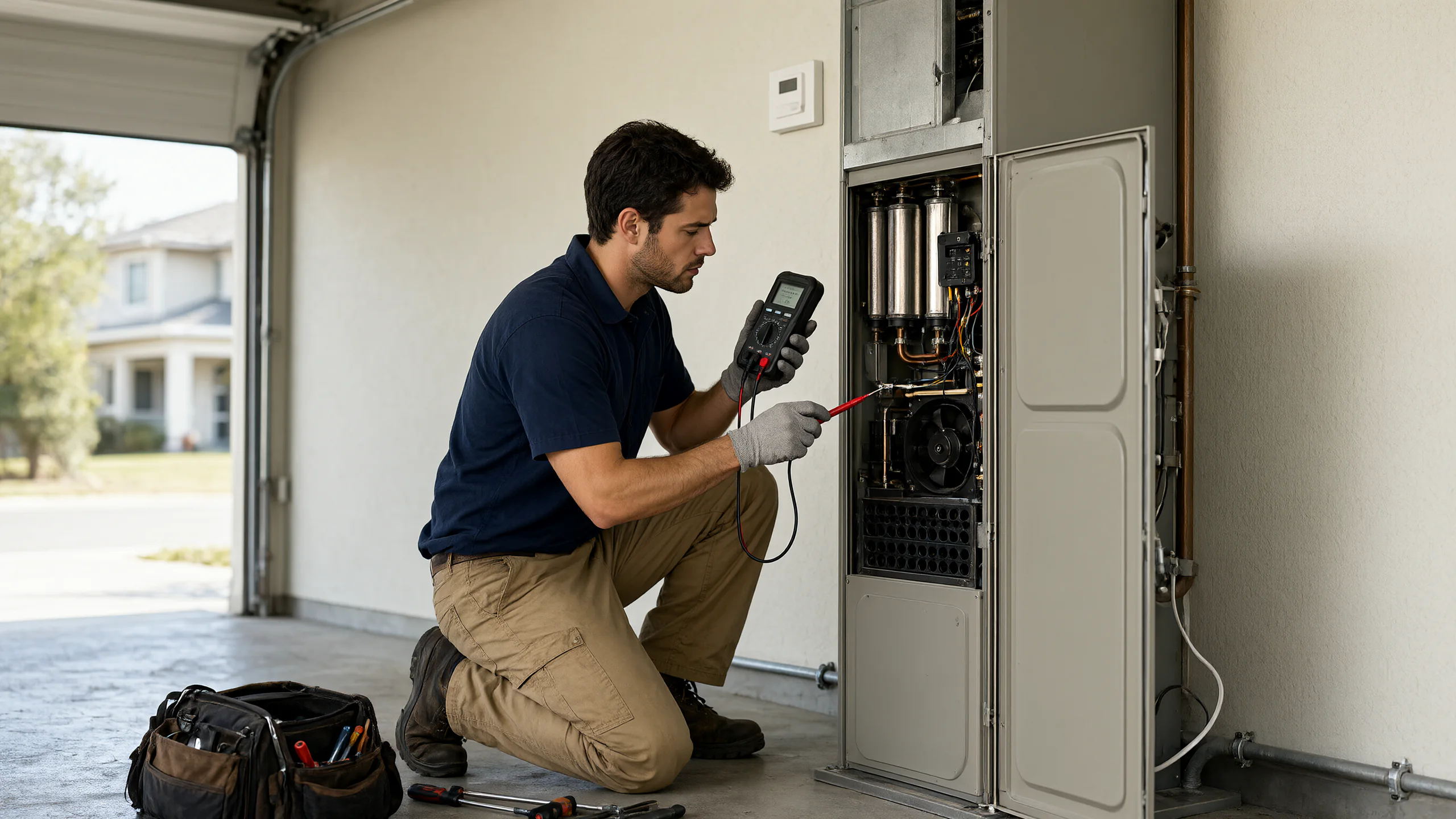
Quick answer: Cold air from your vents usually means the blower is running and the heat never started. Less often, the system makes heat that never reaches the room. Check the register closest to your furnace or air handler. Warm there and cold across the house points to a distribution problem. Cold there means the system isn’t making heat.
Stop Here First: When Cold Air Is an Emergency
If you smell gas, hear a boom or rumble, see soot or scorch marks, or a CO alarm sounds, leave. Get everyone outside, then call SoCalGas at 1-800-427-2200 or 911 from a safe location, per SoCalGas emergency guidance.
Don’t flip light switches on the way out, and don’t ring the doorbell. SoCalGas tells customers not to turn lights or appliances on or off, because a switch can spark. Don’t open the furnace to look, either. Flame rollout and flue spill are fuel problems, not homeowner fixes. From outside, call our emergency line.
The 60-Second Sorting Test
Is the blower running? Hold a tissue against a supply register, then a return grille. A working return pulls it in.
Is the closest register warm or cold? Not the far bedroom. The one nearest the equipment, after five minutes of runtime.
| What you find | What it usually means |
|---|---|
| Blower off, no sound | Power, breaker, thermostat call, blower motor, safety switch |
| Blower on, cold everywhere | Not making heat: ignition, gas, refrigerant, reversing valve |
| Warm near the unit, cold far away | Distribution: duct, return, filter, balance |
| Runs, never warms, stops, retries | Ignition sequence failing, then locking out |
Why a Gas Furnace Blows Cold Air
A gas furnace runs a fixed sequence: thermostat calls, inducer starts, pressure switch proves draft, ignitor heats, gas valve opens, flame sensor proves fire, blower starts. Most boards allow three attempts, then lock out, and the retry pattern shows where the chain broke. If nothing happens, the call never arrived: thermostat mode, dead batteries, or a tripped breaker.
The cabinet is a combustion appliance. Heating repair belongs to someone licensed who owns a combustion analyzer. Reading the sequence is useful. Reaching into it isn’t.
The ignitor doesn’t glow, or the valve won’t open
Hot surface ignitors are ceramic, and they crack. Spark systems click instead. Either way the gas valve gets no signal: the inducer hums for 30 to 60 seconds, then silence.
If the ignitor glows and no flame appears, the valve clicked once and quit: failed operator, a shut-off left part-closed, or low inlet pressure.
Flame sensor can’t prove the flame
This is the no-heat call we run most in the first cold snap. The sensor is a steel rod in the flame. The board pushes a small current through it and measures the return in microamps; oxidation or dust weakens that signal.
There’s no universal pass number. Each manufacturer publishes its own minimum, and a reading that satisfies one brand fails another. A technician measures against your model’s spec, then picks cleaning or replacement.
From your side it looks like a tease: burners light, run three to seven seconds, go out. Three tries, then lockout.
The inducer or pressure switch shuts it down
Before gas flows, the furnace proves it can vent. A blocked flue, a nest in the termination, water in the pressure tubing, or a failing inducer breaks that proof. The draft fan runs longer, with no ignition attempt. Birds in a sidewall vent is a real October call: the cap looks fine from the ground.
The limit switch or rollout switch trips
A high-limit switch opens when the heat exchanger overheats, usually from restricted airflow. The tell is short cycling: burner lights, runs a few minutes, flame drops out, blower keeps running, then it restarts. A loaded filter, dirty blower wheel, or blocked return causes it. Swapping the limit without fixing airflow buys the same call next month.
A rollout switch trips when flame escapes the burner box instead of pulling into the heat exchanger. That points to a blocked flue, a cracked heat exchanger, or another combustion problem. Nobody should reset it to see if it holds.
Heat Pumps: When Cool Air Is the Design
Mild winters here let one heat pump handle both seasons. It doesn’t generate heat, it moves it: the outdoor coil pulls heat from outside air, the compressor raises its temperature, and the indoor coil releases it into your ducts. Supply air runs cooler than furnace air by design.
Defrost is normal, within limits. In cool, damp weather the outdoor coil frosts. The system reverses briefly, the outdoor fan stops, and you may see steam outside. Most manufacturers put a typical defrost at 5 to 15 minutes, every half hour to ninety minutes in wet cold; demand-defrost models often finish in three to five.
What isn’t normal: cycles past 15 minutes, defrost every few minutes, ice that never clears, or a house that never recovers between cycles. Don’t write off a cold house as “just defrost” if the vents stay cool for an hour.
Auxiliary heat covers the gap. Resistance strips run during defrost and cold snaps. If their breaker is off, or aux is locked out at the thermostat, the system runs in heat mode and delivers lukewarm air. Emergency heat is the manual override, and it costs more per hour.
A stuck reversing valve turns your heater into an air conditioner. Stuck in cooling, it runs, moves air, and never warms the house. Fixing it means opening the sealed circuit, so it’s a refrigerant job. Low refrigerant and a silent compressor look similar from the sofa.
Airflow: Heat That Never Arrives
The equipment works perfectly. The heat goes into the attic.
A disconnected flex run. Attic ducts connect to metal boots with a zip tie and mastic. Heat, rodents, and twenty summers loosen them. One room never warms while the rest is fine. Single cold room? Start here.
A crushed duct or separated plenum. Flex pinched behind drywall loses most of its capacity. A trunk separated at the air handler dumps air into the garage and every register feels weak.
A restricted return. A blocked grille, or a bedroom with no return path, starves the blower. Static pressure climbs, and the limit switch starts doing its job.
The filter. A loaded filter chokes the system, and so does a MERV 13 in a slot built for fiberglass. Match the rating to the equipment and check it sits flush.
Duct repair covers disconnected runs; duct sealing covers hidden leaks. A static pressure test says which you need.
Thermostat and Power: The Boring Causes
None of these cost anything to check.
- Mode and fan. Heat, not Cool, and not Auto in a changeover deadband. Fan on Auto, so the blower stops between cycles.
- Schedule and batteries. A smart thermostat on an away schedule ignores the screen. Conventional units click weakly or go blank on dead batteries.
- Power. The air handler has its own breaker, often in a garage or closet, and a full condensate pan trips a float switch that cuts low-voltage power.
- Wiring. After a thermostat swap, a reversing valve wire set for the wrong equipment heats in summer and cools in winter.
A miswired thermostat needs a proper look. That’s what thermostat services are for.
“Cold” Is a Feeling. Temperature Is a Number.
Put your hand over a register and 85-degree air feels cool, because your skin is 98.6. That mismatch causes unnecessary calls and hides real problems. Measure instead: a probe thermometer at the supply register, then the return.
- A gas furnace typically delivers 110 to 130°F, but the real check is temperature rise against the data plate, which is the authority.
- A heat pump typically delivers 85 to 100°F, depending on outdoor temperature and auxiliary heat.
- Supply air within a few degrees of return means no heat is being added, whatever the thermostat claims.
Those ranges are rules of thumb, not standards. An infrared gun reads surface temperature, not air.
ENERGY STAR’s heat pump guidance is the opposite of furnace habits: pick a temperature and leave it. A heat pump may run 15 minutes before the house moves a degree.
The Safety Signs People Talk Themselves Out Of
- A yellow, lazy flame where you’d expect blue and steady. Some orange tips are normal. A soft yellow flame that leaves soot is not.
- Soot on the furnace, the vent, or the wall by a register. Soot means incomplete combustion.
- Flame rolling out of the burner area instead of pulling into the heat exchanger.
CPSC counts more than 200 accidental, non-fire CO deaths a year in the U.S. tied to consumer products, and recommends alarms on every level and outside sleeping areas (CPSC CO center).
California has required CO alarms in existing single-family homes with a fossil-fuel appliance, fireplace, or attached garage since July 1, 2011, under Health and Safety Code section 17926 (Orange County Housing Authority summary). Other dwellings had until 2013. If your alarm went off and you reset it without calling anyone, fix that before heating season.
What Repairs Actually Cost
Ranges come from published third-party data, not our price sheet. We diagnose first, quote after.
| Item | Typical market range |
|---|---|
| Diagnostic or service call | $75 to $200 |
| Furnace repair overall | $125 to $480 |
| Flame sensor, clean or replace | $80 to $250 |
| Ignitor replacement | $100 to $250 |
| Inducer motor | $400 to $1,100 |
| Gas valve | $200 to $800 |
| Blower motor repair | $150 to $700 |
| Heat exchanger | $1,000 to $3,000 |
Every row is from HomeGuide’s HVAC repair cost guide (Tom Grupa, updated July 31, 2025). Its $80 flame sensor repair and $250 replacement produce that row’s range: cleaning versus a new sensor.
Thumbtack’s furnace repair data, updated July 1, 2026, puts the national range at $170 to $735, most homeowners near $352, and the average service fee around $69. A quote far below those numbers makes up the difference somewhere else.
Repair or Replace?
Age and repair history. A furnace lasts 15 to 20 years, a heat pump 12 to 15. One failure in eight years is normal; three in two seasons is a pattern.
A cracked heat exchanger. This ends the conversation. It can let combustion products into supply air, so it’s a safety failure, not a maintenance item.
Refrigerant type. New equipment moved to A2L refrigerants such as R-454B and R-32, and R-410A is being phased down. A quote should name your refrigerant before it names a price.
Comfort you can’t repair. Duct sizing, return capacity, and rooms that were never comfortable are installation problems, which is when heating installation makes sense.
HomeGuide’s rule of thumb is replacing when a unit is over 10 years old and the repair exceeds about 30% of a new system’s cost. A 12-year-old system with one bad sensor is still a repair.
What HiLo Checks on a No-Heat Call
We diagnose before we quote, and we measure.
- Temperature rise and static pressure, against the data plate
- Flame sensor microamps, against manufacturer spec
- Combustion analysis, including CO and draft, on gas equipment
- Inducer draft, pressure switch operation, and the vent termination
- Blower wheel, filter fit, return capacity, and duct connections
- Refrigerant pressures, superheat, subcooling, and defrost on heat pumps
We’re family-owned at 8131 Electric Ave in Stanton, serving Orange County and Los Angeles since 2016 under C-20 license #1155955, with service calls through Anaheim, Santa Ana, Irvine, Huntington Beach, Costa Mesa, and Fullerton.
Most failures here are cheaper to prevent than fix. A fall heating maintenance visit catches a weak flame sensor, a cracked ignitor, and a filter strangling airflow since July. Same blower and filter, so AC maintenance belongs on that calendar.
Frequently Asked Questions
Why is my heater blowing cold air when the thermostat says heat is on?
The thermostat only asks for heat. Cold air with the fan running means the equipment isn’t completing its sequence: failed ignition, a flame sensor that can’t prove flame, a tripped limit, or a heat pump stuck in cooling.
Is it normal for a heat pump to blow cool air in heating mode?
Up to a point. Supply air typically lands in the 80s or low 90s, cooler than skin and warmer than the room, and should hold through the cycle while the house gains heat. Air matching room temperature isn’t normal, and neither is a house that cools between defrost cycles.
How long should a furnace take to blow warm air?
Two to five minutes from the call for heat. The inducer runs, the ignitor heats, burners light, then the blower starts once the heat exchanger warms. Ten minutes of cool air means the sequence failed.
Can a dirty filter really cause cold air from the vents?
It can shut a furnace down. Restricted airflow overheats the heat exchanger, the limit opens, the burner drops out, and the blower keeps running. The air feels cool because the heat source stopped.
Why is only one room cold when the rest of the house is warm?
A distribution clue, not a furnace clue. Usually a disconnected flex duct at an attic boot, a crushed run, a closed damper, or a room with no return path.
Should I turn my heater off if it’s blowing cold air?
Turn it off if the blower runs with no heat, or if you see soot, smell gas, or hear a rumble. A furnace that fails ignition locks itself out anyway. If a CO alarm sounds, leave.
Is it cheaper to repair or replace a heater that won’t heat?
Usually repair, unless the heat exchanger is cracked, an old heat pump needs a compressor, or the unit is past 15 years with a repair history. Get the diagnosis first.
Get the Heat Back On
If the thermostat, filter, and registers check out, the next step is a diagnosis. Call HiLo Heating & Air at (714) 853-5534 or book a heating service call. Tell us whether the blower runs and what the closest register feels like.
Cody
Verified TechnicianLead HVAC Technician & Content Lead
Cody is a lead technician at HiLo Heating & Air with over a decade of hands-on experience repairing, installing, and maintaining HVAC systems across Orange County. He holds EPA Section 608 certification and works under HiLo’s California C-20 contractor license (#1155955). Cody writes HiLo’s HVAC blog to help homeowners understand their systems, spot problems early, and make informed repair-versus-replace decisions.
Need help with this? HiLo can help.
Related services from HiLo Heating & Air:
Related Articles
What Homeowners Should Know Before Replacing a Heating System in Laguna Hills
Thinking about a new furnace in Laguna Hills CA? HiLo Heating & Air covers the warning signs, local sizing, efficiency ratings, and what a proper installation involves.
Read article
Why Heating Systems in a Mild Climate Still Break Down
Odd that a furnace struggles where it barely snows? HiLo Heating & Air explains the hidden costs of infrequent heating use and what a real furnace repair in LA includes.
Read article
Reading the Warning Signs Before a Furnace Fails Completely
Strange furnace noises or a pilot light that won't stay lit? HiLo Heating & Air shares the warning signs and how to decide between furnace repair and replacement in [Rancho Santa Margarita](/service-areas/rancho-santa-margarita/).
Read articleNeed HVAC Help?
Call HiLo Heating and Air today for expert service. Explore our services or find your city.
(714) 853-5534