
New HVAC System Installation: What to Verify Before You Sign the Contract
Written by Cody
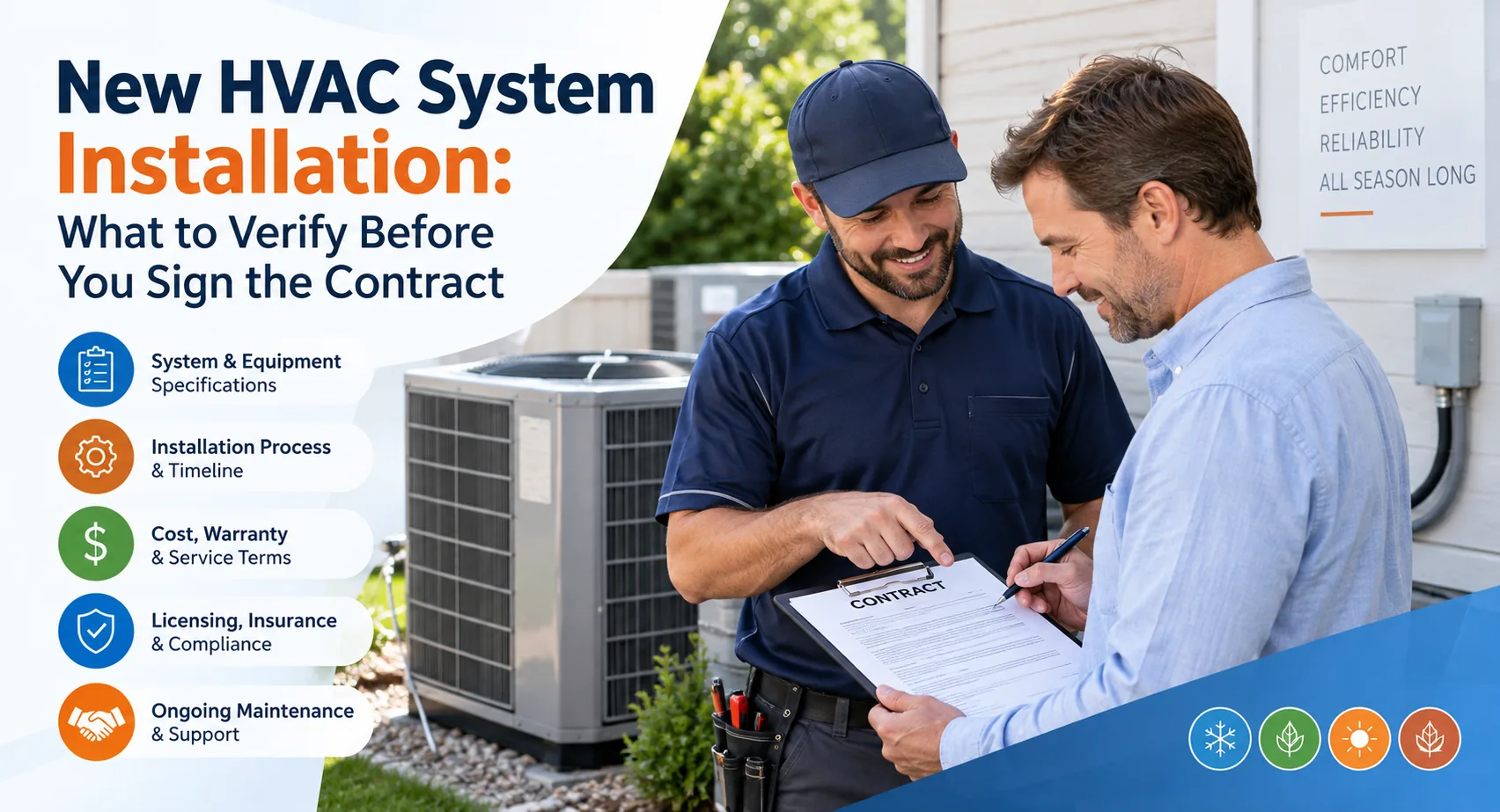
A new HVAC system installation replaces the heating and cooling equipment in a home, and in most cases the ductwork, electrical connections, and refrigerant lines that serve it. It is worth considering when your system is past roughly 12 to 15 years old, needs a repair costing a significant share of replacement, or can no longer keep the home comfortable. The single most important factor is not the brand you buy. It is whether the contractor performs a load calculation and verifies airflow after the install, because an oversized or poorly ducted system will underperform regardless of its efficiency rating. In California, most equipment changeouts also require a permit and independent third-party field verification, which is a useful way to confirm a contractor is doing the job properly.
This guide walks through what a real installation includes, when replacement beats repair, and the specific checks worth making before you sign a contract.
What Does a New HVAC System Installation Actually Include?
It covers more than swapping the box. A complete job addresses the equipment, the distribution system, and the controls.
| Step | What It Involves |
|---|---|
| Old equipment removal | Removing and disposing of the old equipment and recovering existing refrigerant |
| Outdoor unit placement | Setting the new condenser or heat pump on a level pad, with proper clearances |
| Indoor coil or air handler | Installing with a correctly sized and pitched condensate drain |
| Refrigerant lines | Replacing or repairing line sets, then evacuating the lines to a deep vacuum before charging |
| Plenums and transitions | Modifying them so the ductwork matches the new equipment's airflow requirements |
| Electrical work | Verifying electrical capacity, breaker sizing, and wire gauge |
| Commissioning | Measuring airflow, static pressure, temperature split, and refrigerant charge, then documenting the results |
That last step separates a professional install from a fast one. Equipment performance is a claim until someone measures it in your house.
Who Should Replace Instead of Repair?
Replacement usually makes sense in four situations.
| Situation | Why Replacement Makes Sense |
|---|---|
| Compressor or heat exchanger failure out of warranty | These are the two most expensive components, and repairing either on an aging system rarely pays back. |
| System 12 to 15 years old needing a major repair | Compare the repair cost against the remaining useful life, not against the full replacement price. |
| Comfort problems that persist after maintenance and duct repairs | If rooms still will not hold temperature, the system may be undersized, oversized, or badly matched to the duct system. |
| Repairs becoming annual | Two or more service calls in consecutive seasons usually signals broader wear. |
If the system is under ten years old and the failure is a capacitor, contactor, motor, or control board, repair is almost always the better financial decision. A contractor who jumps straight to replacement without documenting a failure deserves a second opinion.
When Is the Best Time to Schedule Installation?
Spring and fall. Installations booked in the shoulder seasons give you time to compare bids, arrange financing, and schedule inspection without living through a heat wave with no cooling.
Emergency replacements in July compress every decision. You end up choosing from whatever equipment is in stock, and permit and inspection timelines still apply. If your system is near end of life, start the conversation before the season it will fail in.
| Timing | What It Means for You |
|---|---|
| Spring or fall (shoulder seasons) | Time to compare bids, arrange financing, and schedule inspection without living through a heat wave with no cooling |
| Peak summer emergency replacement | Choices are limited to whatever equipment is in stock, and permit and inspection timelines still apply |
How Is System Size Determined?
Correctly sized equipment comes from a load calculation, not from matching the tonnage of the old unit. A Manual J load calculation accounts for square footage, insulation levels, window area and orientation, ceiling height, air leakage, and local design temperatures.
Oversizing is the most common error, and it causes real problems. An oversized air conditioner cools quickly, shuts off before it removes humidity, and short cycles, which wears the compressor and produces uneven temperatures.
A good contractor will walk the property, check duct condition, measure return air capacity, and confirm electrical capacity before quoting equipment. That inspection is exactly what the team at HiLo Heating & Air does before recommending a system size on any new HVAC system installation.
The Refrigerant Change Every Buyer Should Understand
This affects anyone buying equipment right now. Under the EPA’s Technology Transitions rule, implemented through the American Innovation and Manufacturing Act, new residential air conditioners and heat pumps can no longer be manufactured or imported using refrigerants above a 700 global warming potential threshold. That moved the industry away from R-410A toward lower GWP A2L refrigerants such as R-454B and R-32.
| Refrigerant | What Buyers Should Know |
|---|---|
| R-410A | Existing R-410A systems remain legal to operate and service, and equipment manufactured before the cutoff can still be installed under the EPA's current rules. |
| A2L (R-454B, R-32) | Lower-GWP refrigerants now used in newly manufactured residential systems. A2L equipment has its own installation requirements, including leak detection and specific line set practices. |
Two practical points follow. First, existing R-410A systems remain legal to operate and service. Second, equipment manufactured before the cutoff can still be installed under the EPA’s current rules, so you may be offered either type. Ask which refrigerant a quoted system uses, and ask how parts and refrigerant availability will look over the equipment’s life. Current details are published on the EPA’s Technology Transitions Program page.
A2L equipment also has its own installation requirements, including leak detection and specific line set practices. Confirm your installer is trained on it.
Permits and Verification in California
Most HVAC equipment changeouts in California require a mechanical permit from the local building department, and many trigger independent field verification under the state’s energy code, administered by the California Energy Commission. Typical verified measures include duct leakage, refrigerant charge, and airflow.
Treat this as a quality check rather than red tape. Independent verification means someone other than the installing crew confirms the system was charged correctly and the ducts are not leaking conditioned air into the attic. If a contractor offers to skip the permit to save money, that is a serious warning sign. It can complicate a future home sale, void manufacturer coverage, and leave you with no recourse.
What Drives Installation Cost
Prices vary by home, so treat any single number online with caution. These are the variables that actually move the quote.
| Cost Factor | How It Affects the Quote |
|---|---|
| System type | A straightforward split system air conditioner installation costs differently than a full system changeout with a furnace or heat pump. |
| Capacity and efficiency tier | Higher SEER2 and variable-speed equipment cost more upfront. |
| Duct condition | Undersized, leaking, or deteriorated ducts add [duct installation](/services/indoor-air-quality-solutions/duct-installation/) or [duct repair](/services/indoor-air-quality-solutions/hvac-duct-repair/), usually worth doing during the changeout. |
| Electrical work | Panel capacity, new circuits, or a disconnect upgrade. |
| Access and location | Attic, closet, rooftop, and crawlspace installs differ in labor. |
| Zone count for ductless | [Mini split installation](/services/air-conditioning-services/mini-split-installation/) cost is driven mainly by the number of indoor heads, line set runs, and whether wall penetrations need patching. |
| Permits and required verification | Mechanical permits and field verification add to a properly done project. |
Rather than guessing, ask for an itemized written quote. HiLo Heating & Air provides free estimates and upfront pricing, and financing is available.
Common Mistakes Homeowners Make
- Choosing equipment by brand before anyone has evaluated the duct system
- Replacing only the outdoor unit and leaving a mismatched indoor coil, which undermines the rated efficiency
- Buying the highest efficiency tier while leaving leaky ducts untouched
- Accepting a quote with no model numbers, no scope of work, and no permit line item
- Skipping the airflow and charge measurements at commissioning
- Ignoring humidity control. In some homes, HVAC humidifier installation or better filtration solves comfort complaints that new equipment alone will not
How to Compare Contractor Bids
Ask every bidder the same questions, and compare the answers rather than the bottom line.
- Will you perform a Manual J load calculation, and can I see it?
- What are the exact model numbers for the outdoor unit, indoor coil, and furnace or air handler?
- Which refrigerant does this system use?
- Is the permit included, and who schedules the required field verification?
- What duct work is included, and what happens if you find problems once the old unit is out?
- What airflow and charge readings will you document at completion?
- What does the labor warranty cover, and for how long, separate from the manufacturer’s parts warranty?
- Are your technicians EPA certified, and what is your contractor license number?
In California, HVAC contractors hold a C-20 license, which can be verified through the Contractors State License Board. HiLo Heating & Air operates under California license #1155955.
Frequently Asked Questions
How long does a new HVAC system installation take?
Most residential changeouts take one to two days. Jobs involving new ductwork, electrical upgrades, or multi-zone ductless systems take longer.
How long should a new HVAC system last?
Roughly 12 to 20 years for central systems, depending on run hours, installation quality, and maintenance. Coastal salt exposure shortens outdoor unit life.
Do I need to replace the furnace and AC at the same time?
Not always, but matched systems perform better. If both are near the same age, replacing together avoids paying for the same labor twice and prevents coil mismatch.
Is a ductless mini split cheaper than a central system?
For a single room, usually yes. For whole-home coverage with multiple zones, a ductless system can cost as much as or more than central equipment. Mini split installation makes most sense for additions, garages, converted spaces, and homes without existing ducts.
Should I replace my ducts when I replace the system?
Inspect them first. If they are leaking, undersized, or collapsed, repairing or replacing them during the changeout is far cheaper than opening the attic again later.
What efficiency rating should I choose?
Match it to your run hours. High-efficiency equipment pays back faster in homes that cool many months a year. In mild-use homes, mid-tier efficiency with excellent installation often outperforms premium equipment installed poorly.
Does a new system need maintenance in the first year?
Yes. An annual check protects the warranty and catches installation issues early. AC maintenance is typically required documentation for manufacturer claims.
Can I install a furnace in a home that only has cooling?
Often yes, though it depends on gas line availability, venting, and combustion air. A heat pump may be simpler. Furnace installation in Laguna Hills, CA and surrounding cities is quoted after an in-home assessment of those specifics.
Do you install systems in new construction as well as replacements?
Yes. New construction work is scheduled around framing and rough-in stages, so it needs earlier coordination than a changeout.
Are commercial installations different?
Yes. Rooftop packaged units, multi-zone controls, and higher run hours change both the equipment selection and the code requirements. Commercial HVAC projects are scoped separately from residential.
Key Takeaway
Installation quality determines how a system performs far more than the badge on the equipment. Insist on a load calculation, a written scope with model numbers, a pulled permit, and documented commissioning readings. Have your ducts evaluated before you finalize equipment, since distribution problems will follow a new system into your home. Ask which refrigerant the quoted equipment uses and what that means for future service. And if your current system is aging but still running, start the process in a shoulder season, when you can compare bids calmly instead of choosing under pressure.
Get a Free Estimate
If you are weighing repair against replacement, or comparing quotes and want a clear second opinion, HiLo Heating & Air can walk your property and give you a written assessment before you commit.
Call (714) 853-5534 or request service through the contact page. Estimates are free, pricing is provided upfront, and financing is available. You can also review AC installation and heating installation options, or check coverage across Orange County and Los Angeles. The team is licensed, bonded, and insured under California license #1155955, with EPA certified technicians.
Need help with this? HiLo can help.
Related services from HiLo Heating & Air:
Related Articles

Commercial HVAC Services in Orange County and Los Angeles: What Business Owners Should Know
Learn what commercial HVAC services cover, who needs them, and how to vet a contractor in Orange County and Los Angeles. EPA-certified technicians, same-day dispatch.
Read article
Why Seasonal HVAC Maintenance Is the Secret to a Comfortable Home Year-Round
Seasonal HVAC maintenance catches small problems before they become expensive breakdowns. Here's why twice-a-year tune-ups matter and what they include.
Read article
What Every Business Owner Gets Wrong About Commercial HVAC Services
Most commercial HVAC system failures are preventable. Here's what business owners get wrong about commercial HVAC services and how to avoid costly emergency breakdowns.
Read articleNeed HVAC Help?
Call HiLo Heating and Air today for expert service. Explore our services or find your city.
(714) 853-5534