
Thermostat Blank or Not Responding? Orange County Fixes
Written by Cody
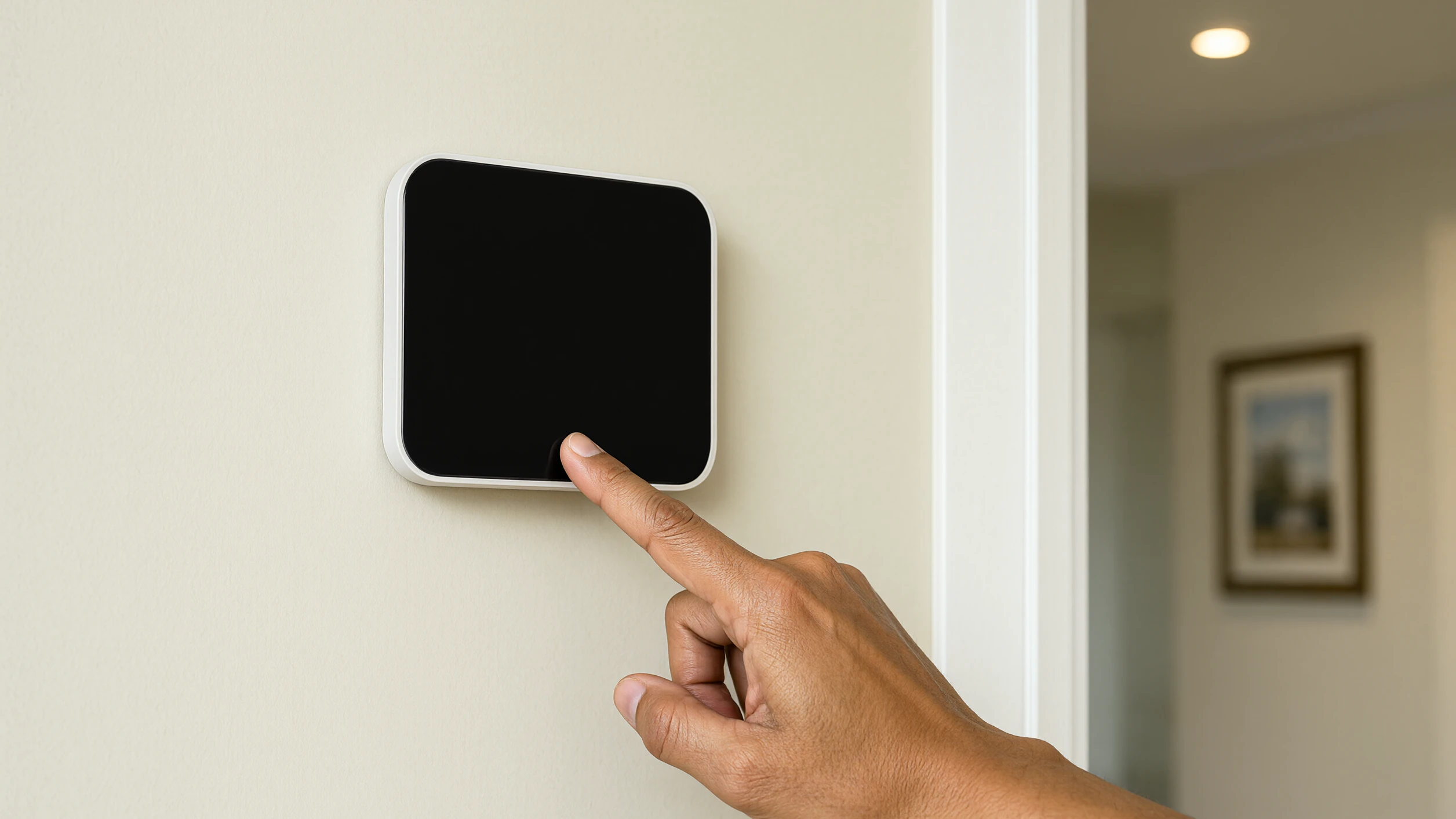
Quick answer: A blank thermostat is usually a power problem, not a dead thermostat. Start with the batteries if your model uses them, then the air handler breaker, then the settings. If the screen stays dark after that, stop. The next step is a meter and an open cabinet, which is not homeowner work.
If you smell burning or see scorch marks at the wall plate, switch the air handler breaker off and call. Do not reset it.
Most November calls start the same way. The system ran fine in September, then one morning the hallway display is dark.
Start With the Symptom, Not the Brand
“Blank” gets used for five different failures, and the fix for one is wasted money on another.
| What you see | What it usually means | First move |
|---|---|---|
| Completely dark screen | No power at the thermostat | Batteries, then the breaker |
| Screen lit, buttons dead | Power is fine, control is not | Keypad lock, hold, mode |
| Display normal, equipment silent | Thermostat calls, equipment does not answer | Stop and call |
| A code, “Wait,” or “Aux” | A reported condition, not a diagnosis | Look it up in your manual |
| Reads the wrong temperature | Sensor, calibration, or location | Compare at the same height |
A dark screen and a locked keypad look identical from across the room. Press a button. If the backlight comes on, you have power and a different problem.
A Blank Thermostat: The Four Things You May Touch
A thermostat doesn’t generate electricity. It runs on batteries, on 24 volt power from a transformer in the furnace or air handler, or both. Honeywell’s wiring guide says the C-wire supplies continuous power and is required on its Wi-Fi models (Honeywell Home, updated January 29, 2026).
1. Batteries. Remove the faceplate per your manual and swap the cells. Do not disconnect wires. Fresh alkaline, 30 seconds.
2. The air handler breaker. It is separate from the big double-pole breaker for the outdoor condenser. If it sits mid-travel, switch it off, wait a few seconds, then back on. One reset only. If it trips again, stop.
3. The settings. Press a button. If the screen lights, power is fine and the fault is a lock, a hold, or a mode.
4. The filter. Change it, and reseat the filter panel you just opened. On many air handlers that panel presses a safety switch, and one that looks closed but is not seated kills the unit. Do not remove any other panel.
Past those four, the rest sits behind a panel.
Where the line is
| Check | Safe for you | Why |
|---|---|---|
| Batteries, breaker reset once, thermostat settings, filter | Yes | No tools, no live parts |
| Blower cabinet beyond the filter slot, service switch, fuse, transformer | No | Needs a meter or an open cabinet |
| Float switch bypass | Never | Can flood a ceiling |
That fuse fools people. Most air handlers carry a small automotive-style blade fuse on the 24 volt circuit. A nicked wire or a rodent shorts it and the stat goes dark. The fuse costs a few dollars, but it is a symptom. Something blew it.
Batteries or C-Wire: Why It Dies in November
Battery models are simple. The cells fade, the screen dims, then it quits. Some keep running the equipment and only lose the display.
C-wire models are different. Many still hold a small internal battery or capacitor charged from the common wire. Some smart thermostats installed without one bleed a trickle of current through the switched wires instead, a practice called power stealing. It works, for a while.
How the stealing works. Between calls, the thermostat lets a small current pass through Y or W to the equipment’s common leg. The load’s resistance keeps it too low to start anything, but high enough to top up the thermostat.
Why it survives summer and fails in heating season. In cooling, the borrowed current passes through the contactor circuit. In heating, it passes through W and the gas valve or heat strip circuit, and some boards don’t tolerate that. The thermostat drains its buffer, the display goes dark or reboots, and it happens the first week the system runs heat every morning.
Why a no-C-wire install fails later instead of immediately. The internal battery hides the problem for months. It gets just enough between cycles to cover the gaps, so the install looks perfect in April and the homeowner blames the thermostat in November. If the stat blanks every time the heat runs, it usually needs a common wire, not a new stat.
Fishing a conductor through stucco or a finished two-story wall is a real job, so a C-wire adapter at the air handler is often cheaper.
Screen On, Buttons Do Nothing
If the display is lit, the thermostat has power. Stop checking the breaker.
Keypad lock. Most models have a child lock. Hold two buttons and the screen shows a padlock. Nothing responds. The release sequence is in your manual. This is the most common “dead” thermostat that is not dead.
Permanent hold. A hold keeps the setpoint where it is and ignores the schedule. The house stays at 78 because someone pressed hold in July.
Mode set to off. Filters get changed, thermostats get bumped, and the mode lands between heat and cool.
Firmware or cloud. Smart thermostats restart during updates. If the app works and the panel doesn’t, the panel is failing.
Wi-Fi and account. Many smart thermostats only join a 2.4 GHz network, so a merged router that steers them to 5 GHz can knock one offline. A unit tied to an old account also shows offline while working at the wall. Check the app first.
A failed touch panel. Capacitive panels fail after years of sprays and sun, and a dead digitizer has no reset.
The Thermostat Reads the Wrong Temperature
A thermostat that says 68 when the room is 74 will run the system into the ground chasing a number that does not exist. Trane’s guide lists the usual suspects: direct sunlight, mounting near a kitchen, and placement above or below a supply register (Trane).
A lamp or a television. A lamp a foot away adds a few degrees of radiant heat. The system shuts off early and the far bedrooms never catch up.
A hole in the wall behind the thermostat. Cable comes through a hole, and nobody seals it. The cavity then acts like a chimney, pulling attic or exterior air across the sensor. Plumber’s putty behind the plate fixes it.
Remote sensors and offsets. If your smart thermostat averages a sensor in a bedroom, the number on the wall is not the hallway temperature. Check which sensors are participating and whether someone set an offset.
A thermometer at the same height, out of sun, is the fair comparison. A degree or two is normal. More than that is placement or a sensor.
Codes, “Wait,” and Short Cycling
A thermostat reports. It does not diagnose.
“Aux” during defrost is normal on a heat pump. “Wait” usually means a built-in compressor delay of a few minutes. A two-digit code points to a condition the board recorded. None of them tell you which part failed. They tell you where to look.
Watch the stat during a short cycle.
- The stat clicks off, then back on. The thermostat is doing its job with a wide differential, or a schedule is fighting your setpoint.
- The stat still says Heat On while the burner drops out. The thermostat isn’t the problem. A limit switch, flame sensor, or pressure switch is opening the circuit.
That second pattern gets thermostats replaced for no reason. The call is arriving and something downstream is refusing it.
When It Is Not the Thermostat
The float switch. A clogged drain fills the pan, the float rises, and the switch opens the 24 volt circuit. The screen goes dark and the AC stops mid-cycle. In coastal Orange County this happens in winter too, not just July, because marine layer humidity keeps the coil condensing when nobody expects it.
The control board fuse. A few dollars in parts, and a short that still needs finding.
The transformer. It steps 120 volts down to 24. When it fails, the thermostat is dark and the board is dead. Testing it takes a meter and a live cabinet.
Low refrigerant. The thermostat is fine, the house is warm, and the coil is frozen. A stat can’t sense charge.
The blower motor or capacitor. The stat calls, the board relays, and the blower never starts. On a furnace, a high-limit switch then shuts the burner down, which looks like a thermostat problem from the hallway.
The most common wasted spend we see is a new thermostat bolted onto a system that never lost power. Nationally, a replacement runs $140 to $350 installed, and a smart replacement $200 to $450 (HomeGuide, August 29, 2025). None of that fixes a tripped float switch or a blown fuse. Putting a new smart thermostat on a weak transformer can leave you with two problems.
If the equipment runs but doesn’t condition, that is an AC repair or heating repair call. If you’re not sure which, HVAC repair covers the diagnosis.
What It Costs
- HVAC diagnostic fee: $75 to $200 (HomeGuide, July 31, 2025).
- Thermostat replacement, installed: $140 to $350. Smart thermostat, installed: $200 to $450. New C-wire run: $90 to $135 (HomeGuide, August 29, 2025).
National figures. Orange County labor often lands above them, so treat the ranges as a floor.
ENERGY STAR puts average savings from a certified smart thermostat at about 8% of heating and cooling bills, or roughly $50 a year, and its own FAQ notes that temperate climates usually see lower savings (ENERGY STAR). That is a national average, not a guarantee for your house. In this climate, it’s a convenience purchase, not a way to recover a diagnostic fee.
We don’t quote repairs over the phone. We diagnose, show you what failed, and price the fix first.
When to Stop and Call
- You smell burning near the thermostat, or see scorch marks or melted plastic at the wall plate. Shut the air handler breaker and call. Do not reset it.
- The breaker trips again after one reset.
- Water is dripping from a ceiling or the pan is overflowing.
- The display works and the equipment never responds.
- Anyone at home is at risk: infants, older adults, or someone with a medical condition.
You may check the batteries, reset the air handler breaker once, adjust thermostat settings, and change the filter. You may not open the air handler, handle line voltage, test a transformer, or bypass a float switch. A bypassed float switch is how a ceiling gets ruined.
A blank thermostat on a mild November afternoon is an inconvenience. The same blank thermostat during a Santa Ana heat wave is a health issue. If you are in the second situation, emergency AC repair exists for it.
What HiLo Checks on a Thermostat Call
- Voltage at R and C, and whether the C-wire is continuous
- Transformer output under load
- Control board fuse and the circuit that blew it
- Float switch operation and the drain that tripped it
- Staging, differential, sensor participation, holds
We are family-owned, at 8131 Electric Ave in Stanton, serving Orange County and Los Angeles since 2016 under C-20 license #1155955. Thermostat services covers replacements, C-wire runs, and smart installations. We run calls through Anaheim, Santa Ana, Irvine, Huntington Beach, and Costa Mesa.
Most blank screens trace back to a battery, a door switch, or a drain line. Catching those before a compressor runs dry is cheaper. A fall heating maintenance visit checks the drain, the float, and the control circuit; spring AC maintenance does the same before summer.
Frequently Asked Questions
Why is my thermostat blank right after a filter change?
The panel that covers the filter probably is not seated, which holds the blower door safety switch open. Reseat the panel you just opened. If the display stays dark, call. Do not remove the cabinet to chase it.
Can a clogged condensate drain blank the thermostat?
Yes. The float switch sits in the low voltage circuit, and rising water opens it. A technician clears the drain and checks the pan. Do not bypass the switch.
Why does a smart thermostat die at the start of heating season?
A unit installed without a common wire charges itself by bleeding current through the switched wires. That often works in cooling and fails in heating, because the furnace board was not designed to supply it.
The screen is on but the buttons do nothing. Is it dead?
Usually not. Check for a keypad lock, a permanent hold, and a mode set to off first. If the panel is lit and unresponsive after a power cycle, the touch panel may have failed.
Why does my thermostat read several degrees off?
Sunlight, a lamp, a supply register blowing on it, or an unsealed hole in the wall behind it. Remote sensors can also pull the average. Compare at the same height, out of sun.
Is a blank thermostat an emergency?
Not by itself. It becomes one when the outdoor temperature is dangerous, someone at home is medically vulnerable, water is leaking, or you smell burning.
Should I replace a blank thermostat myself?
Only after a technician confirms power at the thermostat and the unit has failed. A blank screen is a power symptom, and swapping the stat without finding the cause repeats the call.
Get the Display Back
If the batteries, breaker, settings, and filter all check out, the next step is a meter and a look inside the cabinet. Call HiLo Heating & Air at (714) 853-5534 or request a diagnostic visit. Tell us whether the screen is dark or just unresponsive.
Written by Cody at HiLo Heating & Air, 8131 Electric Ave, Stanton, CA 90680. Sources checked November 2026. Cost ranges are third-party data, not HiLo pricing; every job is quoted after an inspection.
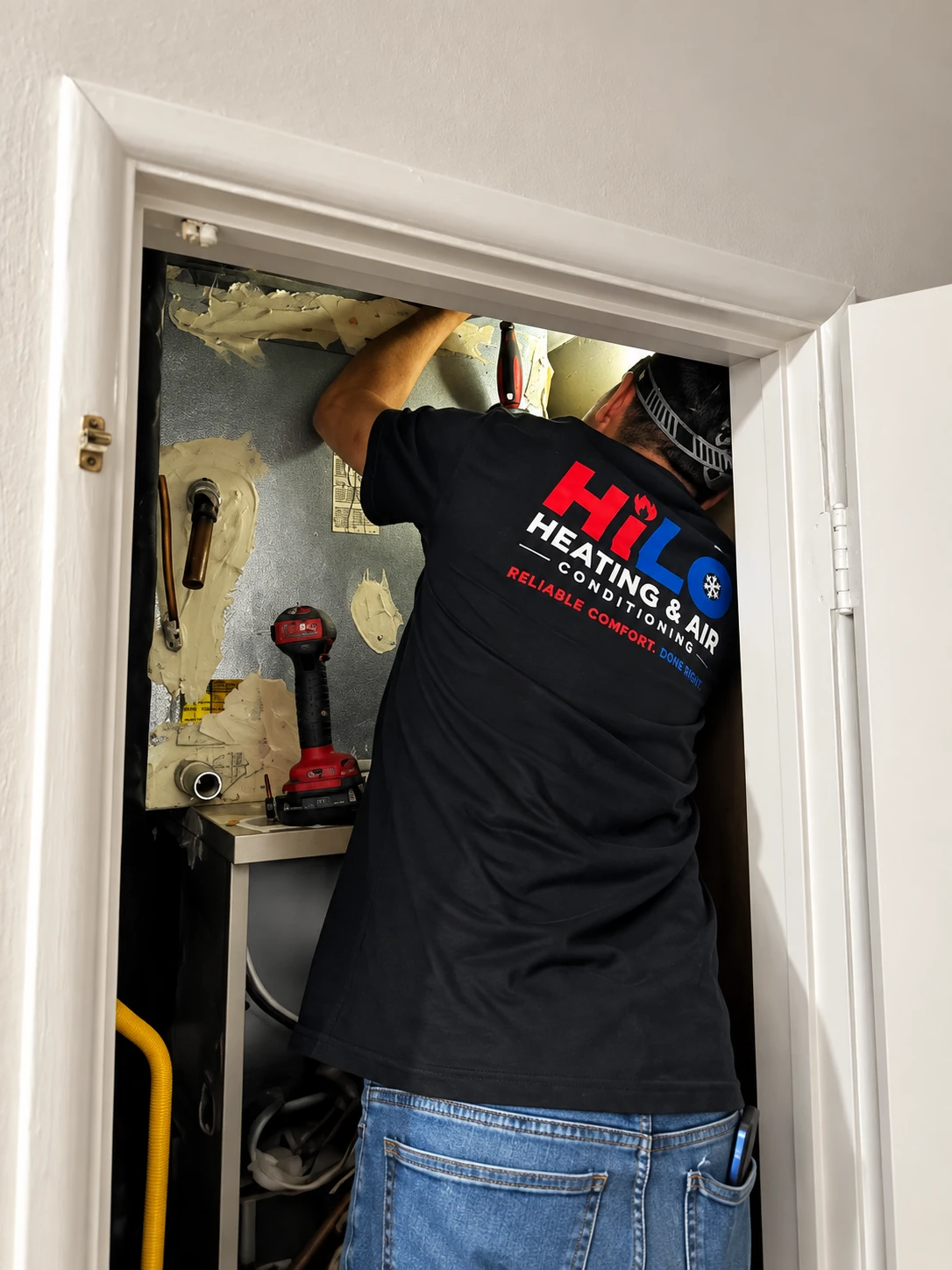
Cody
Verified TechnicianLead HVAC Technician & Content Lead
Cody is a lead technician at HiLo Heating & Air with over a decade of hands-on experience repairing, installing, and maintaining HVAC systems across Orange County. He holds EPA Section 608 certification and works under HiLo’s California C-20 contractor license (#1155955). Cody writes HiLo’s HVAC blog to help homeowners understand their systems, spot problems early, and make informed repair-versus-replace decisions.
Need help with this? HiLo can help.
Related services from HiLo Heating & Air:
Related Articles
AC Leaking Water? Why It Happens in Orange County Homes
Water at the air handler, a ceiling stain, or a drip outside? How Orange County homeowners can find the real cause, stay safe, and stop the damage.
Read article
What Size AC Do I Need? Manual J Sizing for Orange County
Square-foot charts guess. A Manual J load calculation sizes your AC for Orange County heat, glass, ducts, and design temperature. How to check a bid.
Read article
How Long Does an AC Last in Orange County? 12 to 15 Years
Most central ACs in Orange County last 12 to 15 years, not 20. What shortens life here, how to read your unit's age, and when repair stops paying.
Read articleNeed HVAC Help?
Call HiLo Heating and Air today for expert service. Explore our services or find your city.
(714) 853-5534