
Why Your House Feels Stuffy With the AC On in Orange County
Written by Cody
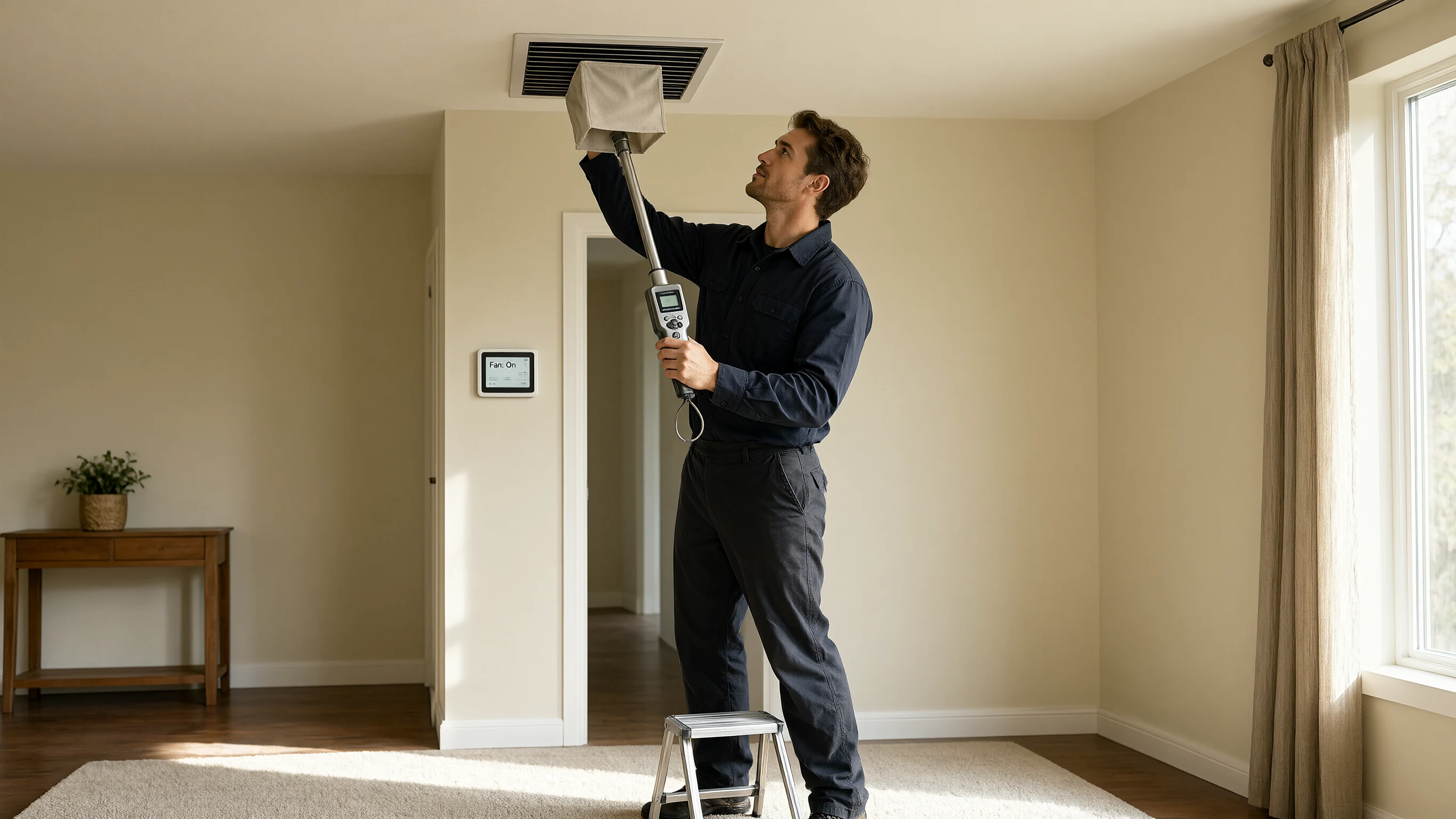
Quick answer: A stuffy house with the AC on is usually one of four problems: too much humidity, stale air with nowhere to go, uneven airflow between rooms, or odors a filter cannot catch. Cooling only solves the first, and only when the system runs long enough to pull water out of the air. Measure before you spend.
Cool and clammy is not the same as cool and fresh. Your skin knows the difference. Your thermostat does not.
That gap explains a lot of service calls where nothing is broken.
What “Stuffy” Actually Means, Broken Into Four Problems
Stuffy is a feeling, not a measurement. Two houses can sit at 74 degrees and feel wrong for different reasons, and the fixes barely overlap.
1. High humidity
The cool-but-clammy version. Skin stays slightly damp. Sheets feel cold and heavy. Tile floors sweat. Towels never fully dry.
Your AC removes moisture as a side effect of runtime, not a setting. The coil gets cold, water condenses on it, and the drain carries it away. If the thermostat is satisfied in eight minutes, the coil barely got wet.
More cooling will not fix that. Longer runtimes will, with correct charge, airflow, and sometimes a dedicated dehumidifier.
2. Stale air and CO2 buildup
Different feeling entirely. The air is cool and dry but somehow used up. You yawn at 2 p.m. You wake up groggy. The bedroom is worse than the hallway, and propping the door open for two minutes improves it. That is the tell.
A closed bedroom with one supply register and no return path is a sealed box someone keeps pumping air into. Supply flow drops off, and two people breathe the same air all night. Cold air makes it worse, because cold air makes you shut the door.
Homes are tight enough now that ventilation has to be deliberate. That is why ASHRAE Standard 62.2 covers dwelling-unit ventilation, local exhaust, and source control. Cooling is not on that list.
3. Uneven temperature and airflow
The stuffy room is also the warm room. Airflow at that register is weak, or it points at a wall, or it sits at the end of a long run.
4. Odors and VOCs
Stuffy with a smell attached. New furniture, fresh paint, new carpet, last night’s fish, the cat box.
A standard filter catches particles, not gas molecules, and cooling does not remove them. Off-gassing from new furnishings peaks in the first weeks and needs ventilation and time.
| Cause | Feels like | Quick test | Right fix |
|---|---|---|---|
| Humidity | Clammy skin, damp sheets | Hygrometer over 55% | Runtime, charge, airflow, dehumidification |
| Stale air | Used-up air, groggy mornings | Improves when a door opens | Ventilation and a return path |
| Uneven airflow | One room stuffy and warm | Weak flow at that register | Balancing, return upgrades |
| Odors / VOCs | Stuffy plus a smell | Smell traces to a source | Source control, ventilation, carbon |
Most homes are a mix of two. The usual pairing is humidity plus a return problem: a damp house where bedrooms have nowhere to push air back to.
The 10-Minute Checks, Before You Call Anybody
Free, fast, and one of them usually solves it.
1. The filter, for condition and fit. Hold it up to a light. Then check fit, the part people miss: a filter sitting in its slot still leaves gaps at the frame, and air takes the gap. Got one at the return grille and another at the air handler? Pick one location and keep it clean.
2. Blocked returns. Find every return grille, not just the supplies. Hold a tissue against it with the system running. No pull means something is blocking it: a sofa, a rug, a curtain, or a remodel that covered the grille.
3. Closed supply registers. Open them all. Closing vents in the guest room feels frugal and backfires: it raises pressure in the duct system, cuts airflow everywhere, and pushes more conditioned air out through attic leaks.
4. The fan switch, Auto versus On. Continuous fan evens out temperature between rooms. It also blows air across a wet coil after the compressor stops, putting that moisture back into the house. Damp and clammy, leave it on Auto. Cold room with humidity under 50 percent, try On.
5. The fresh-air intake and its damper. Some homes have a duct pulling outdoor air into the return. Find it near the air handler. If the damper is closed, taped over, or its controller died, no outdoor air enters on purpose.
6. Bath fans and the range hood. Tissue test at each grille, then go outside and watch the exterior flap. No movement means no airflow. If the duct ends in the attic rather than at a roof cap, that fan is pumping shower moisture into your attic.
Why Orange County Houses Get Stuffy
Mild climate, mild problem? Not quite. A few local conditions stack up.
The marine layer keeps runtimes short. In late spring and early summer, the coast sits under a gray marine layer for days at a time, with outdoor air cool and genuinely damp. The thermostat hits target in minutes, so the coil never gets a long, wet run. The result: a cool house with heavy air, sticky at 72 degrees.
A lot of the housing stock was built with a thin return path. In mid-century tract neighborhoods across Anaheim, Santa Ana, and Garden Grove, the return side often got less design attention than the supply side: sometimes one hallway grille, sometimes a panned return (framing cavities used as the duct path). Closed bedroom doors cut off the only route back. That is a design gap, not a maintenance item.
Two stories, one thermostat. Heat rises, upstairs runs warmer, the downstairs thermostat satisfies first, and the bedrooms above get shortchanged on airflow and long on heat.
Oversized equipment on mild days. An oversized unit is a sprinter asked to run a marathon at a walking pace. It blasts cold air, hits setpoint, and shuts off. Short cycles mean humidity, which means stuffy.
Measure It, Don’t Guess
Guessing is expensive. The wrong guess is a four-figure repair that changes nothing. Start with the cheapest instrument in the trade.
A hygrometer, about $15. The EPA’s Care for Your Air guide says to keep indoor humidity between 30 and 50 percent, and it points homeowners to a moisture or humidity gauge from a hardware store. Read yours in the stuffiest room and one that feels fine, morning and late afternoon.
- Over 55 percent in a cool house points at runtime, charge, airflow, or outdoor moisture arriving through a vent path.
- 30 to 50 percent is the target. In range and still stuffy? Humidity is not your problem.
- Under 30 percent in winter is the opposite complaint, and the one case where a whole-home humidifier is the right tool.
A CO2 meter, if the stale-air theory fits. Put one in a closed bedroom with two adults and the reading climbs overnight. ASHRAE’s position document on indoor CO2 words it carefully: a concentration below 1,000 ppm has long been considered an indicator of acceptable indoor air quality, though it is at best an indicator of outdoor air ventilation per person. Indicator is the operative word. It is a ventilation clue, not a health measurement, and ASHRAE notes plainly that Standard 62.1 does not set a CO2 limit.
What a technician measures that you cannot. Static pressure against the blower’s rated capacity shows whether the system is strangled by a filter, a coil, or undersized ducts. Temperature split between return and supply shows how hard the coil is working. Register airflow shows where the air goes.
Duct sizing follows ACCA Manual D, the ANSI-recognized residential duct design document. Its normative tables set maximum air velocity values for duct airways, supply grilles, return grilles, and door undercuts. An undersized return is a design miss that shows up on a manometer in minutes.
Fixes Ranked by Cost
Cheapest first, because the cheapest fix is right more often than the expensive one.
| Fix | Rough cost | Solves | When it is the answer |
|---|---|---|---|
| Filter, fan setting, open registers, clear returns | $0 to $25 | Mixing and airflow | Always try first |
| Door undercuts or transfer grilles | Low | One closed-off bedroom | Bedroom worse than the hall |
| Duct sealing | $1,000 to $6,000 nationally; $2,000 to $4,000 for a 2,000 sq ft house | Humidity, dust, pressure | Attic or garage ducts |
| Air balancing and return upgrades | Mid | One-room and two-story problems | The stuffy room is also the warm room |
| Dehumidification or designed ventilation | Higher | Humidity or stale air | Humidity over 55% with long runtimes |
| Equipment: Manual J sizing, variable speed, zoning | Highest | Oversized or failing systems | After everything above |
That range comes from HomeGuide’s duct sealing cost data, published in October 2025. The same guide puts a duct inspection at $150 to $500 and a pressure test at $200 to $450. Treat national numbers as a planning floor; local pricing depends on attic access and how much duct is reachable.
The reason sealing keeps coming up: ENERGY STAR reports that in a typical house about 20 to 30 percent of the air moving through the duct system is lost to leaks, holes, and poorly connected ducts. Its symptom list includes stuffy rooms that never seem to feel comfortable, and it flags ducts in an attic, crawlspace, or garage. A return leak in a hot attic does worse than waste energy. It pulls attic air and outdoor humidity into rooms you were cooling.
One caveat on hardware: an ERV transfers moisture along with heat, and in a coastal June that works against you. Around here, a ventilating dehumidifier often does more than a plain heat recovery ventilator.
When It Is Not an HVAC Problem
Some stuffy houses have healthy equipment and another source. Rule these out before anyone sells you a system.
- A closed bedroom with no return path. The most common non-equipment cause.
- New furniture, paint, or carpet. Off-gassing peaks early and fades, so ventilate and give it weeks.
- A dryer vented indoors, or a gas stove with no vented hood. One dumps lint and moisture inside; the other leaves combustion byproducts there.
- A slow water leak. A musty smell that worsens after rain is a building problem. Duct repair will not fix a wet wall.
- Outdoor air quality. Check the South Coast AQMD forecast before you open up the house on a hot, stagnant afternoon. On a bad air day, outdoor air is not the upgrade it sounds like.
What HiLo Checks, and When We Say Don’t Spend
A diagnostic visit is measurement, not a pitch. On a stuffiness call we record static pressure, temperature split, register airflow, return paths, door undercuts, room-by-room humidity and exhaust flow.
Sometimes the honest answer costs us the job: a filter change, a few registers opened, no visit needed. Or ducts deteriorated far enough that sealing them would be money after bad, and replacement is the fairer conversation.
HiLo Heating & Air is family-owned, licensed under California C-20 #1155955, and has worked on Orange County systems since 2016. We are based at 8131 Electric Ave, Stanton, CA 90680, cover Orange County and Los Angeles, and answer at (714) 853-5534.
We work out of Stanton, so Anaheim, Santa Ana, Irvine, Huntington Beach, Costa Mesa, Newport Beach, and Fullerton are inside our normal service area.
If the house still feels heavy after those checks, start with AC maintenance that includes real airflow and humidity readings, or AC repair if the system short-cycles. If the readings point at distribution, our indoor air quality team handles sealing, balancing, returns, and ventilation as one job.
Frequently Asked Questions
Why does my house feel stuffy even with the AC on?
Cooling and ventilating are different jobs. Your AC lowers temperature and removes some moisture while it runs. It does not bring in fresh air, and it will not fix a blocked return or leaky ducts.
Why is my house humid with the AC running?
Usually the system is not running long enough to dehumidify. On a mild coastal day it hits setpoint in minutes, so the coil never gets a long wet cycle. Check the filter, set the fan to Auto, and have charge and airflow checked.
Does running the fan continuously help with stuffiness?
Sometimes. Continuous fan evens out temperature and keeps air moving, which helps a cold-room complaint. It also re-evaporates moisture off the coil after the compressor stops. If the house feels damp, leave it on Auto.
Why is only one room in my house stuffy?
That room loses the airflow fight. It sits at the end of the longest run, has a weak or blocked supply, or has no return path once the door closes. Compare its register to one in a room that feels fine.
Does a stuffy house mean my AC is too small?
Usually the opposite. An undersized system runs constantly and never catches up, which you would notice as warm air. Oversized systems are the likelier culprit: they cool fast, shut off early, and leave the house humid.
Can a dirty filter make a house feel stuffy?
It can, usually as part of a bigger airflow problem. A loaded filter cuts airflow, so less cooled air reaches each room and the coil can freeze. A wrong-size filter lets air bypass the media entirely.
Is a whole-house dehumidifier worth it in Orange County?
Only when humidity is the measured cause. If a hygrometer shows above 55 percent through cooling season and the system already runs long cycles with correct charge and airflow, a dehumidifier does what the AC cannot. At 45 percent, spend the money elsewhere.
The Next Step
Grab a $15 hygrometer and write down two numbers: the stuffiest room and one that feels fine. That comparison beats an hour of guessing.
If the numbers point at humidity, airflow, or a room that never gets air, call HiLo at (714) 853-5534 or request a visit. We measure first and quote after.
Written by Cody at HiLo Heating & Air. Sources checked October 2026. Cost ranges are third-party data, not HiLo pricing; every job is quoted after an in-person inspection.
Cody
Verified TechnicianLead HVAC Technician & Content Lead
Cody is a lead technician at HiLo Heating & Air with over a decade of hands-on experience repairing, installing, and maintaining HVAC systems across Orange County. He holds EPA Section 608 certification and works under HiLo’s California C-20 contractor license (#1155955). Cody writes HiLo’s HVAC blog to help homeowners understand their systems, spot problems early, and make informed repair-versus-replace decisions.
Need help with this? HiLo can help.
Related services from HiLo Heating & Air:
Related Articles
Is Duct Cleaning Worth It in Orange County? An Honest Look
Usually not. What the EPA really says, the three cases that justify duct cleaning, real Orange County 2026 prices, and how to spot a $99 bait quote.
Read article
HVAC Duct Repair in Stanton, CA: Signs, Costs to Consider and When to Replace
Learn the signs your ducts need repair, what it costs to consider, and when replacement makes sense. Local duct repair in Stanton and Orange County.
Read article
HVAC System Inspection in Stanton, CA: What to Expect and Why It Matters
An HVAC system inspection finds the real cause of uneven rooms, weak airflow and high bills. Here is what to expect and why it matters.
Read articleNeed HVAC Help?
Call HiLo Heating and Air today for expert service. Explore our services or find your city.
(714) 853-5534