
AC Leaking Water? Why It Happens in Orange County Homes
Written by Cody
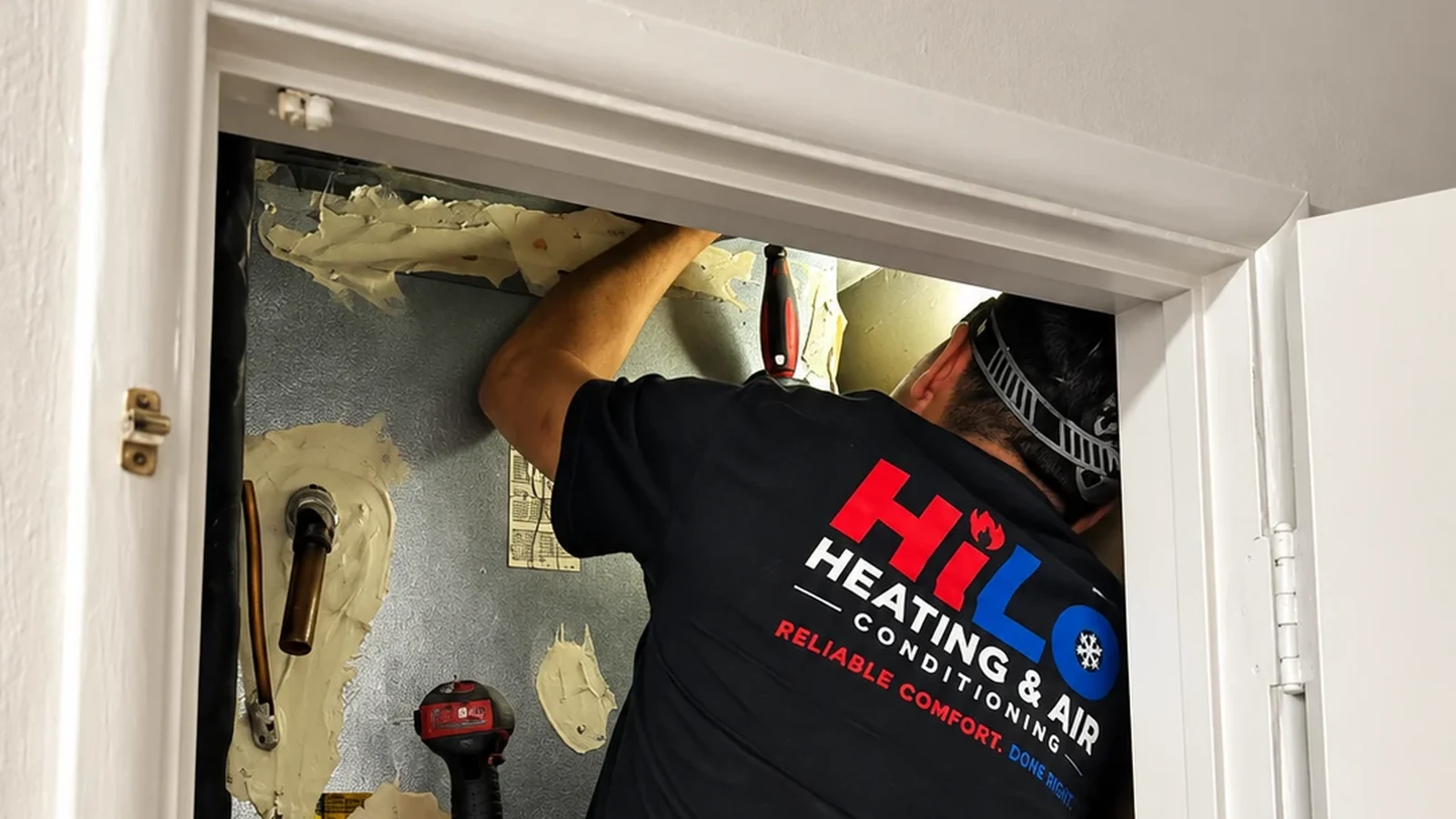
Quick answer: A clogged condensate drain line is the most common reason an AC leaks water inside the house. Turn the system off at the thermostat, mop up what you can, and call before you run it again. If the water is near a ceiling, an electrical box, or an attic air handler, call now and leave it off.
Water on the floor isn’t a diagnosis. Where it lands is.
Most leak advice lists five causes in no useful order. That’s fine for reading and useless at 9 p.m., when water is crossing a closet floor in Anaheim or Santa Ana.
Where the Water Lands Tells You What Failed
| Where you see it | What it usually means | How fast to act |
|---|---|---|
| Puddle in the air handler closet | Clogged line, cracked pan, dead pump | Same day |
| Brown ring on the ceiling under a vent | Attic unit overflow, secondary pan full | Now |
| Drip at the outdoor unit | Normal condensate, or a blocked outlet | Check today |
| Water under a garage air handler | Pan, drain, or a unit out of level | Same day |
| Water only while the fan runs | Fan set to ON, or a dirty coil | Same day |
Water in the air handler closet
The unit hides behind a louvered door in a hallway or laundry. Water here means the pan can’t keep up. The drain is plugged, the pump quit, or the pan cracked somewhere you can’t see. A closet shares walls with bedrooms, so water wicks into drywall fast. The EPA says wet materials dried within 24 to 48 hours of a leak usually won’t grow mold.
A stain on the ceiling under a vent
Stop here. A stain near a vent usually means an attic air handler is overflowing, and the water traveled along framing first.
Drywall holds water, sags, then lets go. Don’t paint over it or run the system to test it. Shut the cooling off and call. Waiting until Monday is how a stain becomes a ceiling repair.
A drip at the outdoor unit
A steady drip from the outdoor condensate line is normal.
What isn’t: a puddle that grows with the system off, ice on the copper lines, or water that never reaches the end of the line. That points to a clog, so mention a dry outlet when you call.
A puddle under a garage unit
Garage units are common in Stanton, Garden Grove, and older Anaheim. They sit on a platform or slab, often beside the water heater.
Follow the water. If it starts under the air handler, the pan or drain is the suspect. If it starts at the water heater, call a plumber. An unlevel unit pools water on one side and overflows.
Water only when the fan runs
First, check the thermostat setting. Fan set to ON runs the blower constantly, pulling humid air across a wet coil and filling the pan with the compressor off. Our thermostat guide explains the fan modes.
Second, a dirty coil throwing water off the fins. That needs a technician.
Why an AC Leaks Water: Five Causes, in the Order We Find Them
1. A clogged condensate drain line
The coil pulls moisture out of the air all day. It drips into a pan, finds the drain, and leaves through a PVC line. That line is dark, wet, and warm, a fine home for algae and dust.
The clog builds slowly. Flow drops to a trickle, the pan holds a puddle between cycles, and one hot afternoon it fills faster than it drains. Water spills into the cabinet or the ceiling below. The house still feels cool. Only the drain failed.
2. A dirty filter that freezes the coil
The coil runs around 40 degrees, well above freezing, because warm room air keeps moving across it. Restrict that air and it gets colder. A matted filter is the usual reason.
Below 32 degrees, frost forms, then ice. Ice blocks the warm air that would melt it, so it grows. When it melts, the pan gets a surge it wasn’t sized for. ENERGY STAR says check the filter monthly and clean or change it when it’s dirty.
3. A failed condensate pump
Orange County rarely has basements, so pumps are less common here. They still show up where gravity can’t reach outside.
A small reservoir fills, a float triggers the motor, and vinyl tubing carries water out. When the pump fails, the reservoir overflows. Seized motors, stuck floats, clogged valves, kinked tubing. Same puddle.
On most installs the switch is wired into the low-voltage thermostat circuit, so it can stop the cooling without tripping a breaker. That’s why a dead pump sometimes shows up as a system that won’t start, not as water.
4. A rusted or cracked drain pan
The pan is a shallow tray under the coil that lives its whole life in water. Metal rusts through at seams and around the drain fitting. Plastic cracks at the corners.
This behaves differently from a clog. A cracked pan leaks with a wide open drain line, usually right under the unit. Past 12 years, a rusted pan is a realistic suspect.
5. Low refrigerant that turns the coil into ice
Low charge drops pressure and temperature in the evaporator. The coil falls below freezing, frost builds, and you get meltwater for the same reason as a dirty filter, except this cause won’t fix itself.
Ice on the copper lines, cooling that fades over weeks, a faint hiss. Handling refrigerant requires EPA Section 608 certification. Topping off a leak without finding it only postpones the call.
Frozen Coil: Why It Cools Fine and Then Quits
The pattern repeats. The AC works for a week or two, then runs without stopping, blows lukewarm air, and the house climbs. Water shows up later, sometimes hours after anyone touched the thermostat.
That’s ice. A frozen coil still passes some air at first, so the house feels fine. As ice thickens, airflow drops, the thermostat never satisfies, and the compressor keeps running.
Then it shuts off and the ice melts at once. A pan built for a steady drip gets a surge. That’s why the leak appears after cooling stops.
Running it frozen makes it worse. Ice insulates the coil, so it runs longer and freezes harder. A coil that cold can send liquid refrigerant back to the compressor, which is how a drain problem becomes a compressor problem.
Turn it off and let a technician find why it froze. Don’t chip the ice or keep resetting the thermostat.
AC Leaking Water From an Attic or Closet Unit
An attic air handler in August sits in one of the hottest places in the house. The pan and drain sit above your bedroom, not in a basement where a leak is merely annoying. A clog that would wet a basement floor elsewhere soaks insulation and drywall here. You learn about it when the ceiling sags.
A secondary pan sits under the whole air handler and catches what the primary misses. It should drain somewhere you’d notice, like an eave, so a drip outside is a warning. A float switch cuts cooling when water reaches it.
The most misread symptom in HVAC: a float switch that keeps tripping isn’t the fault. It’s the messenger. Something is filling the pan. Don’t reset it for another day of cooling. The pan is still filling, and the next thing it overflows into is your ceiling.
The First Hour: What You Can Do Safely
- Turn the system off at the thermostat. OFF, not just a higher setpoint.
- Kill the breaker if water is near an outlet, a disconnect, the electrical compartment, or a ceiling. A closet unit has both water and line voltage.
- Contain it with towels, a bucket, and plastic. Skip the household vacuum, even a wet/dry one, near energized equipment.
- Photograph everything first. Wide shot, close shot, filter. Your tech can use it, and your insurer may ask.
- Check the filter if you can reach it. Gray and matted is useful information.
- Call. Ceiling, electrical box, or attic unit means call now, not Monday. That’s emergency AC repair.
Three things stay off your list. Don’t open the air handler cabinet. Don’t reach in for the drain line or pan. Don’t reset a tripping float switch over and over. A switch that keeps tripping means something is still wrong.
What a Technician Actually Checks
- The line, end to end, plus the trap and slope. A line can be clear at both ends and blocked in the middle. A sagging line holds water.
- The pump. Reservoir, float travel, tubing, check valve. A pump that hums without moving water has still failed.
- The pan. Rust, cracks, pitch. A pan that doesn’t slope pools and overflows.
- The float switch. Lift it and confirm the system shuts down. A switch wired to nothing is worse than no switch in an attic.
- Charge and airflow if the coil froze. Static pressure, filter, blower, coil condition, refrigerant pressures.
What It Costs
National ranges from published cost guides, not HiLo prices. Orange County labor, attic access, and system age move the number.
| Job | Typical national range | Source and date |
|---|---|---|
| Diagnostic or service call | $75 to $200 | HomeGuide, Aug 22, 2025 |
| Drain line flush | $75 to $250 | HomeGuide, Aug 22, 2025 |
| Clearing a clogged drain line | About $150 | Thumbtack, updated Jul 10, 2026 |
| Condensate pump replacement | $100 to $450 | HomeGuide, Aug 22, 2025 |
| Secondary drain pan replacement | $250 to $600 | HomeGuide, Jul 22, 2025 |
| Primary drain pan replacement | $600 to $1,200 | HomeGuide, Jul 22, 2025 |
Ask whether the diagnostic fee is credited toward the repair. A primary pan costs more because it’s built into the coil assembly.
How to Keep It From Happening Again
Filters are a monthly habit in this climate, not an annual one. Check it monthly, replace it when it’s gray, and don’t stretch one past three months. Pets, a dusty street, or a remodel mean more often.
Service the drain before summer, not after the first leak. ENERGY STAR’s checklist includes the condensate drain because a plugged drain can cause water damage in the house. Flush, trap, slope, switch. That belongs in a real AC maintenance visit, not an upsell.
Pan tablets slow growth, nothing else. They treat water sitting in the pan, do nothing for a clog already in the line, and won’t save a cracked pan.
A shop vac buys time, at the outdoor end only. With the system off, a wet/dry vac on the outside termination can pull a soft clog loose. It won’t fix slope, a trap, a failing pump, or a frozen coil, and it’s no reason to open the cabinet. Most clogs that come back within a week were never cleared at the trap.
When the Leak Is Really a Refrigerant or Airflow Problem
Some leaks are airflow or charge problems wearing a puddle.
- The leak returns within days of a drain clearing.
- Ice appears on the copper lines or coil.
- Airflow feels weak, or one room never cools.
- The system runs constantly and misses the setpoint.
- A musty smell follows the water.
If those fit, the drain was the symptom. Start with a real AC repair diagnosis rather than another flush. If the problem traces to the ducts, duct cleaning or duct repair may be the fix, especially in older homes with undersized returns. If the water sat long enough to smell, our indoor air quality services cover the moisture side.
What HiLo Checks Before We Quote Anything
HiLo Heating & Air is family owned and has worked on Orange County and Los Angeles County homes since 2016. We’re based in Stanton, at 8131 Electric Ave, Stanton, CA 90680, licensed as a California C-20 contractor under #1155955.
On a leak call, we work that checklist in front of you and explain what failed before we quote. If the coil froze, airflow and charge get checked first. You get the cause in plain language and a price before any work starts.
We work throughout Anaheim, Santa Ana, Irvine, and Huntington Beach, along with the rest of Orange County. Call (714) 853-5534 or send us the details.
FAQs
Why is my AC leaking water inside the house?
A clogged condensate drain line is the usual cause. Water backs up in the pan and spills into the cabinet or onto the floor. A frozen coil, failed pump, cracked pan, and low refrigerant are the others.
Is it safe to run my AC if it’s leaking water?
No. Turn it off at the thermostat, and kill the breaker if water is near electrical parts or a ceiling. Running it adds water and can damage the compressor if the coil is frozen.
Why does my AC leak only when the fan is running?
Check whether the fan is set to ON instead of AUTO. A constant fan pulls humid air across a wet coil and keeps making condensate. If the setting is right, a dirty coil may be throwing water.
Why does water appear after the AC shuts off?
That’s a frozen coil thawing. Ice builds while the system runs, then melts at once when it stops, and the pan overflows.
How much does it cost to fix an AC water leak in Orange County?
Nationally, a drain flush runs $75 to $250 and a pump replacement $100 to $450, per HomeGuide (Aug 22, 2025). Secondary pans run $250 to $600 and primary pans $600 to $1,200, per HomeGuide (Jul 22, 2025).
Can I clear the drain line myself with a shop vac?
You can try it at the outdoor end with the system off, and it sometimes works. It won’t fix a bad slope, a missing trap, a failing pump, or a frozen coil.
My float switch keeps tripping. Can I bypass it?
No. The switch is doing its job. Something is still filling the pan, and bypassing it removes the only thing between a clog and your ceiling.
Still got water where it shouldn’t be? Call HiLo at (714) 853-5534. We’ll find the source before we quote the repair.
Cody
Verified TechnicianLead HVAC Technician & Content Lead
Cody is a lead technician at HiLo Heating & Air with over a decade of hands-on experience repairing, installing, and maintaining HVAC systems across Orange County. He holds EPA Section 608 certification and works under HiLo’s California C-20 contractor license (#1155955). Cody writes HiLo’s HVAC blog to help homeowners understand their systems, spot problems early, and make informed repair-versus-replace decisions.
Need help with this? HiLo can help.
Related services from HiLo Heating & Air:
Related Articles
How Long Does an AC Last in Orange County? 12 to 15 Years
Most central ACs in Orange County last 12 to 15 years, not 20. What shortens life here, how to read your unit's age, and when repair stops paying.
Read article
Why Does My AC Smell? A Guide for Orange County Homes
Musty, burning, chemical, or rotten egg? Match the AC smell to its real cause, learn which ones mean shut it off now, and see what repairs cost in OC.
Read article
AC Repair Anaheim: Warning Signs, Common Failures, and Smart Decisions for Homeowners
AC repair in Anaheim — learn the warning signs, common failures, simple pre-call checks, and how to choose a qualified HVAC technician in Orange County.
Read articleNeed HVAC Help?
Call HiLo Heating and Air today for expert service. Explore our services or find your city.
(714) 853-5534