
Why Does My AC Smell? A Guide for Orange County Homes
Written by Cody
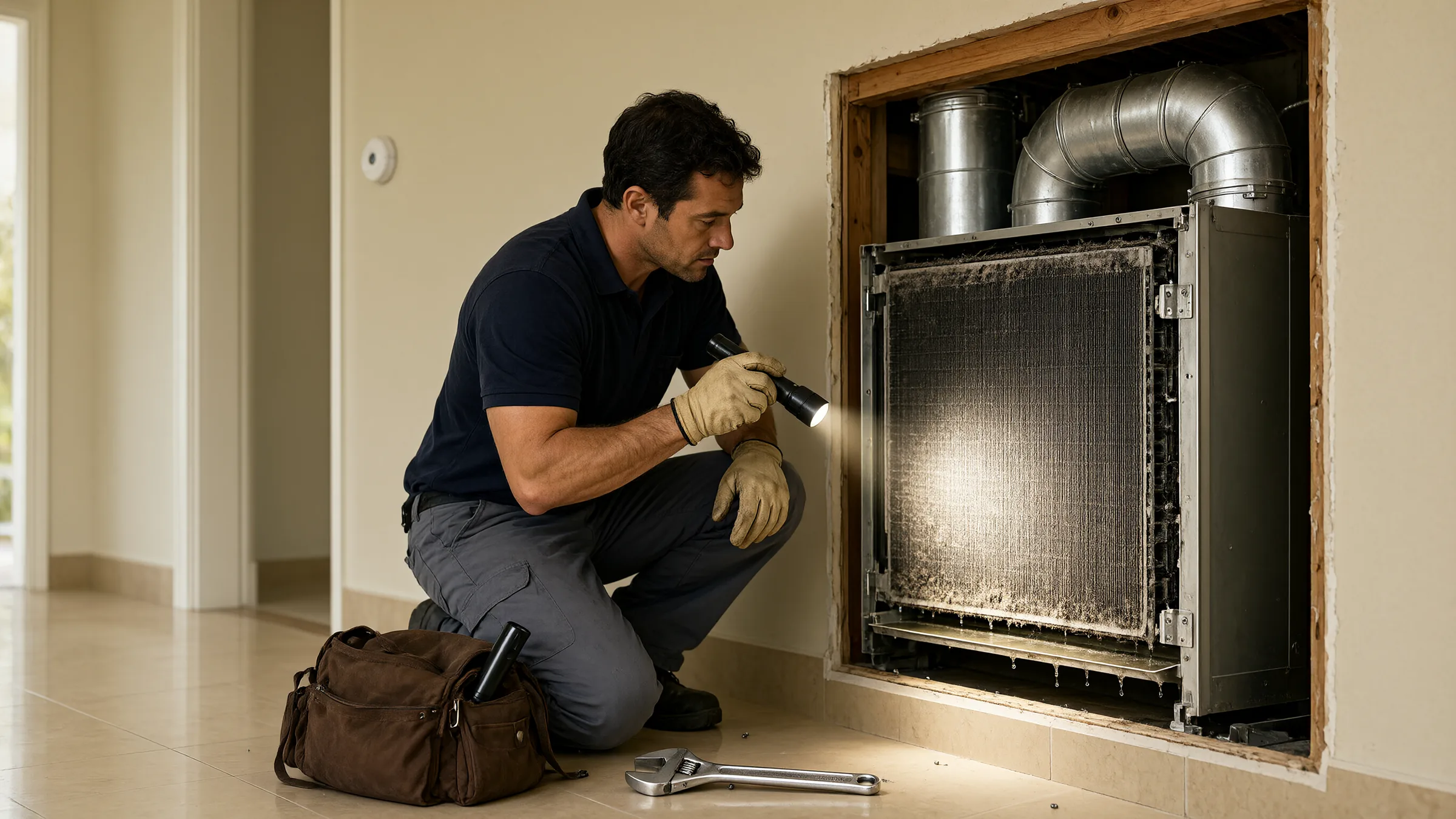
Quick answer: Musty or dirty-sock air means moisture is feeding growth on the coil, in the drain pan, or inside damp duct liner. Burning or electrical means shut it off at the thermostat, then the breaker, and call. Rotten egg means gas, so leave and call the utility from outside. Chemical, dead-animal, and exhaust odors point somewhere else. Exhaust is the third emergency.
Most advice flattens six different failures into one answer: clean your ducts. A burning blower motor and a wet coil share nothing except the vent the smell comes out of.
The Smell-to-Cause Table
| What you smell | Most likely source | Urgency | First action |
|---|---|---|---|
| Musty, damp, dirty socks | Wet coil, standing water, clogged drain, damp liner | This week | Look for water at the indoor unit |
| Burning, hot plastic, ozone | Blower motor, capacitor, contactor, wiring, debris on a heat strip | Emergency | Off at the thermostat, then the breaker |
| Rotten egg, sulfur | Gas, sewer gas, dry P-trap | Emergency if gas | Leave. Call the utility from outside |
| Chemical, solvent, sharp | Refrigerant leak, coil cleaner, new parts off-gassing | Same day | Ventilate, shut it off, call |
| Dead animal, decay | Carcass in a duct, the return, or a wall cavity | Within days | Find the source. Do not mask it |
| Exhaust, gasoline | Vehicle exhaust, backdrafting, cracked heat exchanger | Emergency if strong indoors | Get out, ventilate, call |
Safety Gate: Three Smells That Change the Plan
Burning or electrical. Turn the system off at the thermostat so it stops calling for cooling, then kill the circuit at the breaker. Don’t run it again to see whether the smell clears, and don’t open the air handler. Heat, line voltage, and a fan motor in a closet is a fire that starts where you cannot see it. If you see smoke or flame, get out and call 911.
Rotten egg or sulfur. Get everyone out and call your gas utility from outside. Don’t flip switches, unplug anything, or use your phone until you’re clear of the house. If you hear hissing, or anyone feels dizzy, call 911 from the street. SoCalGas’s guidance is the same: evacuate first, call second.
Chemical or solvent. Open windows, shut the system off, call a technician. Section 608 requires certification for anyone servicing equipment that could release refrigerant, and knowingly venting it is illegal. Ours hold it. Ask before anyone touches your lines.
If you are past deciding, emergency AC repair beats a scheduled visit.
A Musty Smell Is a Water Problem Wearing a Costume
Dirty-sock air is one of our most common calls, and it’s almost never a smell problem. It’s a moisture problem that ran long enough to grow something.
Your coil sits around 40 degrees. Room air crosses it, water condenses, and drips into a pan and out a drain. When part of that chain fails, the coil stays wet between cycles and the pan holds a shallow puddle. Dust collects, and bacteria and mold do the rest.
The EPA’s mold guidance names these as hidden moisture problems: poorly draining condensate pans inside air handling units, and porous liners inside ductwork. Both sit inside your system, so you smell it before you see it. The CDC puts it shorter: if you smell mold, remove it and fix the moisture.
- A clogged condensate line. Algae builds in the trap, water backs up, the coil stays damp. This is the usual cause of a smell that appears from nowhere in July.
- A pan that does not drain. Pans should slope toward the drain. Some never did, and some lost the slope when the unit settled.
- Liner that got wet and never dried. An overflow or a disconnected flex run can soak fiberglass liner. The EPA is direct: contaminated liner cannot be cleaned back to neutral, no registered biocide exists for porous material, so it gets replaced.
Burning or Electrical Smell Means Stop
A burning smell during cooling season isn’t normal, and it isn’t dust burning off.
What we find, in order: blower motor windings overheating, a blower wheel seizing on its bearings, a failing capacitor dragging the motor down, a pitted contactor arcing.
The thermostat isn’t the switch that matters. Off stops the call for cooling but leaves 240 volts at the air handler, and it won’t stop a stuck contactor from energizing the outdoor unit. Kill the breaker, then call.
One exception, because it causes a panic every October: the first time you run the heat, dust burns off the heat exchanger and smells like a hair dryer for 10 minutes. A burning smell in August is not that.
Chemical or Solvent Smell Does Not Mean What the Internet Says
Search this and you’ll be told refrigerant smells sweet. The manufacturers half agree, and that’s the problem.
Honeywell’s safety data sheet for R-410A describes an “ethereal and faint sweetish” odor. A leak you can smell from the hallway has been running a while, and plenty give you nothing at all. You find those with gauges and an electronic detector.
So the rule is not “sweet equals leak.” An unexplained chemical smell is a shut-it-off-and-call smell, and don’t assume you know which chemical it is. Coil cleaner, fresh paint, and new flex duct all land in that bucket.
New systems sold here since 2025 use lower-GWP refrigerants, and many are A2L, meaning mildly flammable. The EPA’s phasedown FAQ notes that industry standards prohibit charging R-454B or HFC-32 into a system not designed for them. That also explains why a top-off from a friend with gauges is a bad idea. Low refrigerant means a leak, and adding gas without finding it turns a small repair into a compressor.
Rotten Egg Smell Is Usually Not Your AC
Cooling equipment doesn’t make sulfur compounds. If the smell only gets worse when the blower runs, the system is moving air past a source that already existed.
A dry P-trap. Water in a trap is the seal that keeps sewer gas out. Guest baths and garage drains go unused for months, the water evaporates, and the house smells like a drain. Run water 30 seconds in each drain. If the smell fades by tomorrow, you found it.
A sewer or vent fault. A blocked vent stack or failed wax seal puts sewer gas in the house persistently. That is a plumber.
Dead Animal in a Duct or Return
Rodents, birds, and lizards get in through open flex runs in attics and gaps at the outdoor unit. When one dies inside, the smell is strongest at one vent, worse when the fan runs, and it fades over two to four weeks.
One vent and not the others means the source is local to that branch, so a whole-house cleaning is usually the wrong invoice. Duct cleaning doesn’t fix this. A carcass leaves fluid in the liner, and fluid in porous material does not come out with a brush and a vacuum. The EPA says insulation that is wet, moldy, or holding an unacceptable odor should be removed and replaced. NADCA’s own guidance starts with source removal, not spraying.
The fix has three steps: find the animal, remove it and everything it touched, replace that section, seal the entry point.
Exhaust or Gasoline Smell Is a Carbon Monoxide Problem
Vehicle exhaust indoors is a safety call, not an AC call. The usual path is an attached garage: a car idling with the house door open, a generator near a return, a mower parked against a shared wall.
A backdrafting water heater flue or a cracked heat exchanger can also push combustion gas into the air stream in heating season, and the blower spreads it. You can’t smell carbon monoxide on its own, so exhaust odor is the warning you get before a detector goes off.
Treat it as an emergency if the smell is strong indoors. Get people and pets outside, ventilate only if it is safe to go back, and call 911 if a CO alarm sounds or anyone has a headache, nausea, or dizziness.
Why Orange County Homes Get This More Than National Advice Admits
Generic advice is written for an Ohio house with a basement. Four local patterns change that.
The marine layer keeps coils wet. From May through July, coastal cities sit under humid air most mornings. Anaheim and Fullerton are milder than Huntington Beach or Costa Mesa, but a house running short bursts never gets a dry cycle.
Oversized systems never dry the coil. The EPA notes that an oversized unit cycles frequently and removes moisture poorly. A system that satisfies the thermostat in seven minutes removed heat and no water. Runtime and humidity readings on an AC maintenance visit say more than a thermostat.
Air handler closets with no return. Plenty of 1960s through 1980s tract homes put the unit in a louvered closet with no dedicated return, so the cabinet runs humid and sweats.
Aging liner inland. Homes built in Anaheim, Santa Ana, and Garden Grove between 1960 and 1985 often have lined sheet metal or early flex. It’s 40 to 65 years old, and damp liner holds odor. It can’t be cleaned back to neutral, so replacement is a duct scope.
What Actually Fixes It, by Cause
These are third-party national ranges, not HiLo pricing, and we diagnose before quoting. Filters and drain maintenance are yours. An open panel, refrigerant, or line voltage is not.
Coil and plenum cleaning. HomeGuide’s coil guide (August 22, 2025) puts an in-place evaporator cleaning at $100 to $400, or $400 to $700 with the coil removed.
Drain pan and condensate service. HomeGuide’s HVAC repair guide (July 31, 2025) lists a drain line flush at $75 to $250, a drain tube replacement at $100 to $195, and a pan replacement at $250 to $1,200.
Duct cleaning, only when the ducts are the source. Thumbtack (updated July 10, 2026) shows $225 to $619 typical, about $374 for a standard job. The EPA cites $450 to $1,000 per system. Neither fixes a wet coil or removes odor from saturated liner. If duct or liner has to be replaced, HomeGuide puts it at $25 to $55 per linear foot.
Diagnosis. $75 to $200 nationally per HomeGuide (July 31, 2025). Anyone quoting a smell repair over the phone is guessing, including us. If a motor or contactor turns out to be the cause, that becomes AC repair.
On UV lights and “air purification.” Be skeptical of anyone promising a UV lamp will sterilize a house. A lamp at the coil can slow growth on the surfaces it reaches, and only after the coil is clean, since UV does not get through dirt. It doesn’t treat the air at residential doses, and it does nothing about the water feeding the growth. Our indoor air quality team will tell you when filtration is the honest answer.
Prevention That Actually Works
Change the filter on a schedule, not a feeling. A 1-inch filter in heavy summer use is a 30 to 60 day part. A 4 or 5 inch media filter goes 6 to 12 months.
Leave the fan on Auto. Continuous fan blows room-temperature air across a wet coil for hours after the compressor stops, and puts that moisture back into the house. Some thermostats offer a fan-off delay that dries the coil instead. A thermostat service visit can turn it on.
Maintain the drain. Pour a quarter cup of distilled white vinegar down the condensate line monthly in summer, then flush with water.
Hold indoor humidity between 30 and 50 percent. That’s the EPA’s guidance, and a $15 hygrometer is enough.
Seal the ducts you can reach. Leaky attic runs pull in insulation fibers and damp outdoor air. Duct sealing and duct repair are often the cheapest ways to keep a coil dry.
Frequently Asked Questions
Why does my AC smell musty when it starts, then fade?
The first blast crosses a coil and plenum that sat damp, carrying the most odor. Fading doesn’t mean it resolved.
Is a musty AC smell dangerous?
Not an emergency like a gas leak, but not something to leave either. The CDC says damp, moldy environments may cause a stuffy nose, sore throat, coughing, burning eyes, or skin rash in some people, and people with asthma may react more severely.
My AC smells like burning plastic for a minute, then stops. Is that fine?
No. A one-time smell when you first run the heat is dust burning off the heat exchanger. During cooling it points at a motor, capacitor, wiring, or contactor.
Can I spray something into the return to kill the smell?
No, and it usually makes things worse. Fragrance adds compounds without removing the growth or the water, and the EPA registers no antimicrobial for lined ductwork.
Does a sweet smell mean my AC is leaking refrigerant?
It can, but smell is weak evidence. Data sheets describe R-410A as faintly sweetish, and small leaks often produce no smell at all. If the smell is chemical and you cannot place it, shut it off and have it tested with gauges.
Do UV lights or air purifiers stop AC smells?
Rarely, and never alone. A lamp at the coil can slow growth on the surfaces it reaches. It can’t fix a wet pan or saturated liner, and no residential lamp sterilizes a house.
How much does it cost to fix an AC smell in Orange County?
It depends on the cause. Nationally a diagnostic runs $75 to $200, coil cleaning $100 to $400, a drain flush $75 to $250, and duct cleaning $225 to $619 when the ducts are the source.
The Next Step
Before you call, look for standing water at the base of the indoor unit and the drain pan, and set the fan to Auto to see whether the smell changes. Don’t remove panels.
If you are in Anaheim, Santa Ana, Irvine, Huntington Beach, Costa Mesa, or Fullerton, we are close. Call (714) 853-5534 or request a visit. Family owned since 2016, CA C-20 license #1155955.
If the smell is burning, or you smell gas, skip the form. Kill power at the breaker, or leave the house, and call.
Written by Cody at HiLo Heating & Air, 8131 Electric Ave, Stanton, CA 90680. Sources checked October 2026. Cost ranges are third-party data, not HiLo pricing; every job is quoted after an inspection.
Cody
Verified TechnicianLead HVAC Technician & Content Lead
Cody is a lead technician at HiLo Heating & Air with over a decade of hands-on experience repairing, installing, and maintaining HVAC systems across Orange County. He holds EPA Section 608 certification and works under HiLo’s California C-20 contractor license (#1155955). Cody writes HiLo’s HVAC blog to help homeowners understand their systems, spot problems early, and make informed repair-versus-replace decisions.
Need help with this? HiLo can help.
Related services from HiLo Heating & Air:
Related Articles

AC Repair Anaheim: Warning Signs, Common Failures, and Smart Decisions for Homeowners
AC repair in Anaheim — learn the warning signs, common failures, simple pre-call checks, and how to choose a qualified HVAC technician in Orange County.
Read article
AC Repair in Anaheim: Same-Day & 24/7 Emergency Air Conditioner Repair From a Licensed C-20 Contractor
Same-day and emergency AC repair in Anaheim, CA from HiLo Heating & Air. Licensed C-20 contractor (#1155955), EPA-certified technicians, and free diagnostics with any repair. Call (714) 853-5534.
Read article
Keeping Cool in a City That Rarely Gives Your AC a Break
Wondering why your AC wears out fast in LA? HiLo Heating & Air explains common signs, what a real repair visit should cover, and the habits that cut emergency calls.
Read articleNeed HVAC Help?
Call HiLo Heating and Air today for expert service. Explore our services or find your city.
(714) 853-5534