
Furnace Making Noise? What Each Sound Means in Orange County
Written by Cody
Quick answer: A bang at startup followed by a whoosh is delayed ignition. Shut the furnace off at the thermostat and call, because repeated bangs stress the heat exchanger. Squealing is usually a bearing or a belt. Rattling, clicking, humming, and whistling point to vibration, electrical parts, or airflow. The airflow checks are the only ones a homeowner should touch.
Before You Diagnose Anything
A furnace making noise is doing one of three things: vibrating, moving air badly, or burning fuel at the wrong moment. Only the first two are yours.
Stop and call if you smell gas, see soot on the cabinet or vent, see a yellow lazy flame, hear a CO alarm, or hear a bang followed by a delayed whoosh.
Gas smell or CO alarm: don’t touch the thermostat or flip a switch on the way out. Get everyone outside and call SoCalGas at 1-800-427-2200, or 911 if you can’t reach them (SoCalGas emergency information). A switch can spark.
A bang with no gas smell: shut it off at the thermostat and call.
Don’t open the cabinet, touch the gas valve, or pull the burners. Those are combustion parts. The filter, registers, and thermostat are yours. Everything behind the panel belongs to someone licensed. If you’re past that line already, our emergency line is staffed for it.
The Noise-to-Cause Table
Urgency means whether the furnace should keep running tonight.
| Noise | Likely source | Urgency | What to do |
|---|---|---|---|
| Banging at startup, then a whoosh | Delayed ignition | High | Shut it off and call for heating repair |
| Rattling that follows the blower | Loose panel, duct, or blower wheel | Medium | Press a hand on the panel. Quiet means tighten screws |
| Clicking, three tries then silence | Ignition retry, then lockout | Medium | Note the pattern and call |
| Squealing | Blower bearing, belt, inducer | Medium to high | Stop running it if the pitch climbs |
| Humming or buzzing | Transformer, contactor, capacitor | Medium | No air moving means shut it off |
| Whistling | Filter, return, duct leak | Low | Change the filter, then call if it holds |
| Grinding or metal scraping | Blower wheel rubbing its housing | High | Shut it off |
| Rumbling | Burner, inducer, or heat exchanger | High | Shut it off, especially if it continues after the burner stops |
Banging on Start-Up Is Fuel, Not Sheet Metal
This is the call people talk themselves out of. Someone hears a boom, a neighbor says “that’s just the ducts,” and the furnace runs three more weeks.
The sequence in a healthy unit: thermostat calls, inducer starts, pressure switch proves the flue, ignitor heats, gas valve opens. Ignition should follow within a second with a soft whoosh.
When ignition is late, gas keeps flowing with nothing to burn it. It finally catches, and the whole pocket lights at once inside a metal box. That’s the bang.
Common causes: an aged ignitor that glows but no longer reaches ignition temperature, dirty burner ports, a burner out of alignment, low manifold pressure, or a blocked carryover channel.
Each bang sends a pressure spike through the burner box and heat exchanger. Repeat it and you can distort the burner box, crack a weld, or force flame out of the vestibule instead of into the flue. A cracked heat exchanger can put combustion products into supply air.
Don’t reset the breaker to see if it holds. It won’t, and you’ll add another bang on the way to the same diagnosis.
Ducts don’t wait for the gas valve. A boom you feel through the cabinet is inside the unit. Expansion is a tick that travels across a ceiling a minute into the cycle.
Rattling: Panels, Ducts, and the Blower Wheel
Most common call, least dangerous.
Access panel. Screws back out and panel metal resonates at blower frequency. Press a hand flat while it runs. If the rattle stops, tighten with a nut driver, snug not cranked. Don’t remove the panel.
Ducts. Flex duct resting on a joist, a trunk strapped too tight, a loose plenum seam. The sound comes from a wall or ceiling, not the equipment. Rigid duct from the 1950s and 1960s in Anaheim and Santa Ana has had decades to loosen.
Blower wheel. The one that matters. The squirrel cage collects dust unevenly, goes out of balance, and shakes. A set screw can loosen until the wheel rubs the housing. It starts with the blower, not the burner, and worsens as the motor speeds up.
A thump that repeats with each rotation is the wheel. Grinding or scraping means shut it off. A screw dropped in the compartment during the last service will rattle for years, and we find one or two a season.
Clicking: Ignition Sequence vs. a Relay That Won’t Latch
Some clicking is normal: thermostat, pressure switch, gas valve.
The pattern that matters is click, click, click, no heat. The board is running its sequence, failing to prove flame, retrying. Three attempts, then lockout.
Usually it’s a cracked ignitor that glows at the edges but won’t light gas. Or a flame sensor that lets the burner run a few seconds and drop it. Or a valve that clicks without opening.
One pattern gets missed: a failing 24-volt transformer sags under load, so the board relay chatters instead of latching, often with a dimming display. That’s electrical, not a parts swap.
A clicking thermostat with a dim screen is usually batteries. That’s what thermostat services are for. If the clicks come from the furnace, the sequence is failing. Our guide to a heater blowing cold air walks the same chain.
Squealing: Bearings, Belts, and the Inducer
A squeal is friction with a pitch. Where it lands in the cycle names the part.
Blower bearing. Sealed on modern equipment, so there’s nothing to oil. When one dries out, the squeal starts a minute into the cycle, changes pitch as the motor warms, and sometimes chirps at startup. Joshua Smith, operations manager at Berkshire Heating and Air Conditioning, told Family Handyman that motor bearings “can start to go bad or get dirt stuck in them” (blower motor guide, updated Sept 2024). A blower that howls and never reaches speed is on its way out.
Belt. Older belt-drive units. A glazed or loose belt slips and shrieks at startup, then quiets as it grips. Belt dressing makes it worse by attracting dust. Replace the belt, then check tension.
Inducer. Runs before and after the burner. A bad bearing gives a high whine at the start and a descending whine on spin-down. This part vents combustion gas, so it’s not wait-and-see.
Humming and Buzzing: Three Parts, Three Sounds
A steady low hum is usually the transformer. A little is fine. Loud means failing or overloaded.
A loud buzz that settles into a hum is the contactor pulling in, pitted contacts, or a relay chattering.
Then the sound that should stop you: the blower humming with no air moving. That’s a motor trying to start against a failed capacitor or a seized bearing. It heats, trips its overload, retries. Shut it off. A capacitor is cheap. A cooked motor isn’t.
A buzz that travels through walls and stops with the blower is vibration, not electrical.
Whistling: Air Moving Too Fast Through Too Small a Hole
Whistling is pressure: air accelerating through a restriction.
Start with the filter. Loaded media forces air through the gaps around it, and a filter too restrictive for the slot does the same. ENERGY STAR’s maintenance checklist says to inspect or change the filter monthly and notes that airflow problems can cut system efficiency by up to 15 percent (maintenance checklist).
A return too small for the blower raises static pressure, and a whistling grille is a sizing clue. Common where a room was added or a grille got covered by furniture.
Then dampers and leaks: a manual damper half closed, a zone damper stuck mid-travel, an unsealed boot.
Filters and registers are yours. The rest needs a static pressure reading. Duct sealing handles leaks, duct repair handles crushed or disconnected runs.
Rumbling: When It’s Combustion, Not Metal
A low roar that starts and stops with the burner is combustion. Dirty burner ports, low gas pressure, weak draft, or a shifted burner that lets flame lift.
A rumble that continues after the burner stops is different, and worse. Gas is still burning somewhere it shouldn’t, or an inducer bearing is coasting down. Shut it off and call. Don’t wait for Monday.
You can’t hear a CO reading. A combustion analyzer measures oxygen, CO, stack temperature, and draft. If the rumble comes with soot, a yellow flame, or a CO alarm, treat it as a safety call. CPSC links more than 200 accidental, non-fire CO deaths a year to consumer products, and wants an alarm on every level and outside sleeping areas (CPSC CO center).
What’s Normal, So You Stop Worrying About the Wrong Thing
A furnace should sound like a furnace. Baseline from a healthy unit:
- A soft whoosh within a second or two of ignition
- A few clicks at startup, ending in flame
- Ticking or light popping in the first ten minutes as metal expands, and again after shutdown
- The inducer running 30 to 60 seconds before and after
- Gentle airflow at the registers, not a roar or a whistle
The line between normal and not is when it happens, not how loud it is. Expansion ticks arrive a minute or more into the cycle and come from the ceiling or the floor, away from the cabinet. Delayed ignition bangs at the instant the gas valve opens, comes from the furnace itself, and ends in a whoosh. If the sound lands with ignition, treat it as fuel. Loudness only tells you how much gas lit at once.
Record ten minutes on a cold evening. “It bangs twice, a minute after the thermostat clicks” beats “it’s loud.”
What the Repair Actually Costs
Published market ranges, not our price sheet. We diagnose first and quote after, because the same noise can come from a fifty dollar part or a two thousand dollar one.
| What you heard | Part it usually points to | Market range |
|---|---|---|
| Banging at ignition | Hot surface ignitor | $100 to $250 (HomeGuide) |
| Clicking, no flame | Gas valve | $200 to $800 (HomeGuide) |
| Squeal at startup, belt-drive | Blower belt | $5 to $100, part only (Bob Vila, Nov 28, 2022) |
| Squeal a minute in | Blower motor replacement | $300 to $900 (HomeGuide); $400 to $600 single speed, $600 to $1,300 variable (Thumbtack, Jul 1, 2026) |
| Humming with no airflow | Capacitor | $179 to $250 installed (Thumbtack) |
| Rumbling or a failing inducer | Inducer motor | $400 to $1,100 (HomeGuide) |
| Rumbling with soot or a yellow flame | Heat exchanger | $1,000 to $3,000 (HomeGuide) |
HomeGuide’s guide, July 31, 2025, puts furnace repair overall at $125 to $480, labor at $75 to $150 an hour, and a diagnostic visit at $75 to $200. Thumbtack’s national range is $170 to $735, most near $352, average service fee $69. Ask whether that fee comes off the repair.
A belt is cheap. The visit isn’t, which is why a belt squeal belongs with a fall tune-up. A heat exchanger turns a repair into a replacement conversation.
What HiLo Checks on a Noise Call
We ask when in the cycle the sound happens first. That narrows it faster than anything else, and a noise call is a running call, so we can test under load.
- Blower and inducer amp draw against nameplate
- Capacitor microfarads under load
- Wheel balance, set screw torque, bearing play
- Static pressure and temperature rise
- Manifold and inlet gas pressure at the data plate
- Burner alignment, carryover channels, flame sensor microamps
- Combustion analysis, then a heat exchanger inspection
- Panel screws, gaskets, duct connections
We’re family-owned, at 8131 Electric Ave in Stanton, CA 90680, serving Orange County and Los Angeles since 2016 under C-20 license #1155955. Noise calls come from Anaheim, Santa Ana, Irvine, and Fullerton in the first cold snap.
The furnace that sat idle since March is the one that bangs. Dust settles in the burner compartment, spiders build in the inducer orifice, and the ignitor has had eight months to age quietly. A fall heating maintenance visit catches most of it before the first cold night.
Frequently Asked Questions
Why does my furnace bang when it starts?
Delayed ignition. Gas opens before it lights, pools, then burns all at once. A soft whoosh within a second of the valve opening is normal. A boom, or a whoosh several seconds late, is not. Shut it off and call.
Why is my furnace making noise all of a sudden?
Usually because it sat idle. Dust in the burner compartment, a drier blower bearing, and a looser panel all surface on the first cold night. The exception is a bang at ignition, which is fuel, not dust.
Why does my furnace click but never light?
The board is running its ignition sequence and failing to prove flame. Usually a weak ignitor, a dirty flame sensor, or a valve that isn’t opening. Most boards lock out after three tries.
Is a squealing furnace dangerous?
Less often than a banging one, but don’t ignore it. A seizing blower can trip the limit, and a failing inducer can stop venting gas. Shut it off if the pitch climbs.
Can a dirty filter really make my furnace whistle?
Yes, and it’s first on the list. A clogged filter forces air through gaps at higher velocity. Change it, listen again, then call.
What does it cost to fix a noisy furnace?
It depends on the part. A belt is a small parts line. A blower motor, inducer, or heat exchanger is not. Expect a diagnostic visit in the $75 to $200 range before any repair quote.
Should I shut my furnace off if it’s making noise?
Shut it off for banging, grinding, scraping, a blower that hums without moving air, rumbling after the burner stops, or any noise with soot, a yellow flame, gas smell, or a CO alarm. Rattling and whistling can wait.
Get the Noise Diagnosed Before the Cold Week
If the sound is new, repeating, and timed to ignition, don’t run it another season. Call HiLo Heating & Air at (714) 853-5534 or book a heating service call. Tell us what it sounds like, when in the cycle, and whether the blower or burner is running. That sentence halves the diagnosis.
Cody
Verified TechnicianLead HVAC Technician & Content Lead
Cody is a lead technician at HiLo Heating & Air with over a decade of hands-on experience repairing, installing, and maintaining HVAC systems across Orange County. He holds EPA Section 608 certification and works under HiLo’s California C-20 contractor license (#1155955). Cody writes HiLo’s HVAC blog to help homeowners understand their systems, spot problems early, and make informed repair-versus-replace decisions.
Need help with this? HiLo can help.
Related services from HiLo Heating & Air:
Related Articles
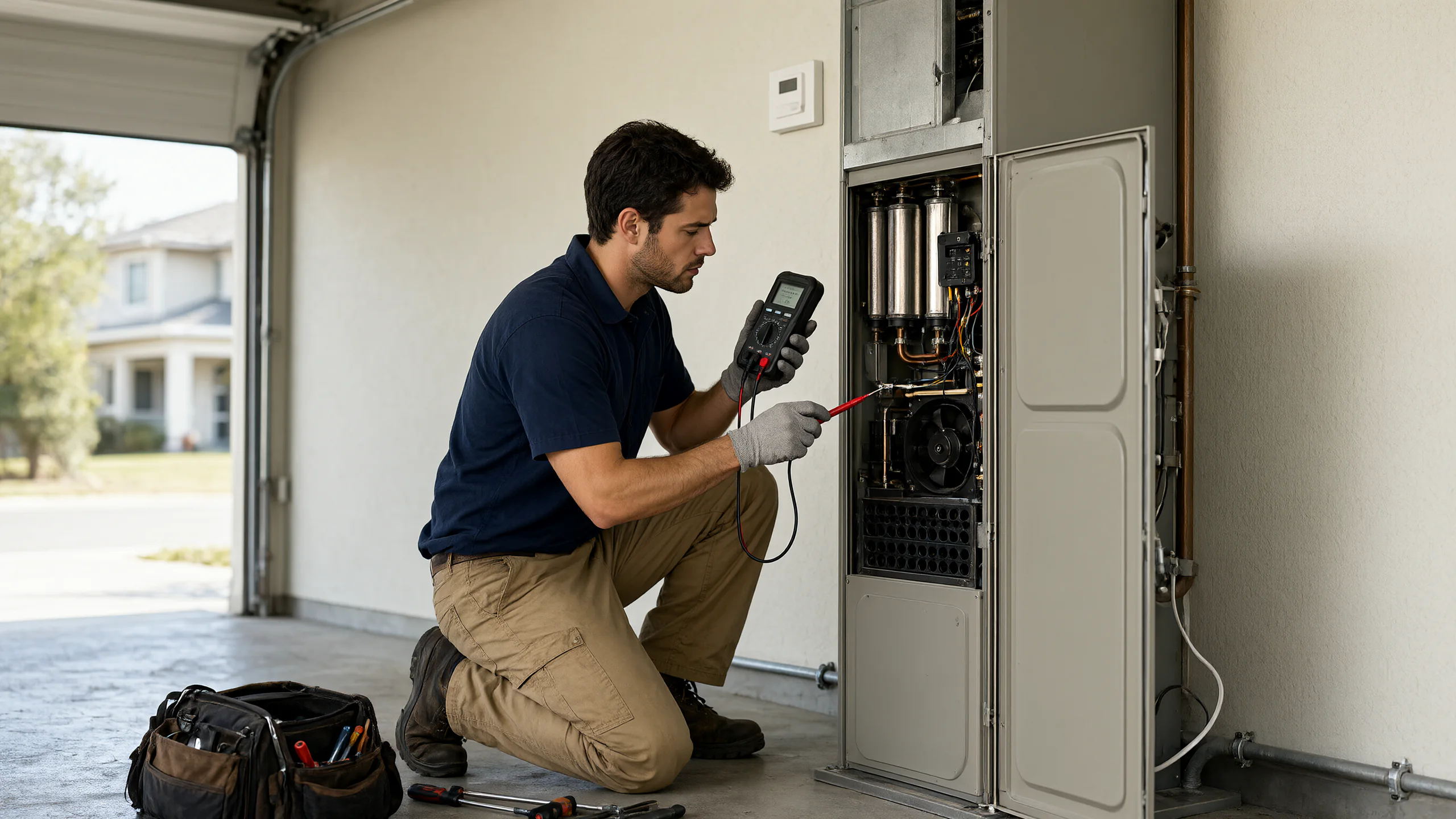
Heater Blowing Cold Air? A Technician's Diagnostic Guide
Heater blowing cold air? Learn whether your system is failing to make heat or failing to deliver it, plus the quick checks an Orange County tech runs.
Read article
What Homeowners Should Know Before Replacing a Heating System in Laguna Hills
Thinking about a new furnace in Laguna Hills CA? HiLo Heating & Air covers the warning signs, local sizing, efficiency ratings, and what a proper installation involves.
Read article
Why Heating Systems in a Mild Climate Still Break Down
Odd that a furnace struggles where it barely snows? HiLo Heating & Air explains the hidden costs of infrequent heating use and what a real furnace repair in LA includes.
Read articleNeed HVAC Help?
Call HiLo Heating and Air today for expert service. Explore our services or find your city.
(714) 853-5534