
HVAC Replacement Cost in Orange County (2026 Prices)
Written by Cody

Quick answer: A full system, meaning a new furnace and AC with the existing ducts reused, runs $5,000 to $11,000 nationally. Add ductwork and the band moves to $7,000 to $16,000. Orange County contractors who publish local numbers put the same work at $10,000 to $22,000, so treat the national figures as a floor, not a prediction.
Scope moves the number more than brand: whether your ducts, line set and panel survive the job, and what California requires before the permit closes. Every range below is dated, and where a source contradicts itself, both are here.
Cost by project type
Every figure below is national. Coastal California labor, permits and Title 24 compliance usually land above them.
| Project | Typical installed range (national) | Source |
|---|---|---|
| Straight AC changeout (condenser and coil, existing ducts) | $2,500 to $7,500 | HomeGuide, Aug 27, 2025 |
| Gas furnace replacement | $3,800 to $12,000 | HomeGuide, Dec 31, 2025 |
| Full system, AC plus furnace, no new ducts | $5,000 to $11,000 | HomeGuide, Aug 27, 2025 |
| Full system with new ductwork | $7,000 to $16,000 | HomeGuide, Aug 27, 2025 |
| Heat pump system with air handler | $10,000 to $25,000+ | HomeGuide, Oct 30, 2025 |
| Duct replacement | $1,400 to $5,600 | HomeGuide, Dec 19, 2025 |
| Electrical panel upgrade to 200 amps | $1,300 to $2,500 | HomeGuide, Dec 30, 2024 |
Two rows contradict their own sources. HomeGuide’s furnace page headlines $3,500 to $7,500+, quotes $3,800 to $12,000 for gas in the body, and its HVAC page lists $2,000 to $5,400. Those are different products: a basic 80% unit against a 96% two-stage with new venting. The panel row does the same, $1,300 to $2,500 for an upgrade and $1,800 to $2,500 for a new service.
Thumbtack’s marketplace data (September 22, 2025) is wider and less useful: $3,725 to $20,449, typical job near $11,862, and a low end that reflects small jobs.
A changeout and a full system are not the same product
A changeout swaps equipment that fits what you already have: same tonnage, footprint, line set, ducts and panel. HomeGuide calls it a one-day job at $5,000 to $11,000, and it is the cheapest legitimate path to a new system.
A full system replacement includes the parts that feed the equipment: ducts, line set, electrical capacity, sometimes the platform and drain. That is the $7,000 to $16,000 band before a panel upgrade.
When one bid says $7,400 and another says $14,200, do not ask who is cheap. Ask whether both wrote down the same scope. Usually they did not.
What HVAC replacement costs in Orange County versus the national numbers
Orange County is not a national market. Two local contractors who publish their own pricing put a full AC and furnace replacement between roughly $10,000 and $22,000 in 2026, with 3-ton packages at $16,000 to $21,000 (South County Air Services; J Martin Indoor Air Quality).
The difference is scope and code: a permit and inspection, Title 24 duct sealing with HERS verification in many cases, and a panel check on 1960s and 1970s tract homes built with 100 amps. Attic runs sit at 140 degrees by noon, and stucco walls do not want a new line set.
So read the table as a floor. Then read a $6,000 bid here as a question: what was left out.
What actually moves the price here
Tonnage, properly sized. A 2-ton system installed runs $2,500 to $5,500 nationally. A 5-ton runs $4,000 to $8,000 (HomeGuide, Aug 27, 2025). Sizing should come from a Manual J load calculation, which ACCA publishes as the national ANSI-recognized standard (ACCA). A rule of thumb based on square footage is not a calculation.
SEER2 tier. At 14 to 15 SEER2, a heat pump system installs for $6,000 to $12,000 nationally. At 20+ SEER2 you are at $15,000 to $25,000 (HomeGuide, Oct 30, 2025). The top tier buys real efficiency and a much longer payback, so ask for both prices and do the division.
Stories and access. A single-story ranch with a garage-mounted air handler is the easy version. A two-story with one unit in a closet and a second in the attic is not. A condenser craned onto a roof adds money and scheduling.
Duct condition. Ducts last 10 to 20 years. If yours are original to a 1980s build, they are at the end of that window, and a high-efficiency system pushing more static pressure through leaky ducts wastes the upgrade. Duct sealing runs $400 to $1,900 for manual sealing nationally, and duct repair is cheaper when the runs are intact (HomeGuide, Dec 19, 2025).
Line set length. A condenser moved to a side yard forty feet from the coil is not a straight swap either. Longer runs cost $15 to $25 per foot (HomeGuide, Oct 30, 2025).
Panel capacity. A heat pump pulls more amperage than a gas furnace blower. If the panel is full or still 100 amps, a 200-amp upgrade adds $1,300 to $2,500 (HomeGuide, Dec 30, 2024).
Paperwork and cleanup. Permits run $100 to $250 for a replacement and $250 to $1,500 with duct work (HomeGuide, Aug 27, 2025). Some California jobs also require HERS verification of duct sealing or refrigerant charge before the permit closes. Removal and disposal adds $100 to $200 on a changeout and $200 to $500 on a heat pump, and a smart thermostat is $200 to $500 if it is not in the bid (HomeGuide, Oct 30, 2025).
The five things that must be in the quote, in writing
A verbal estimate is not a quote. Ask for these five and do not sign without them.
- Equipment model numbers, indoor and outdoor. “Carrier 3-ton” is not a model number.
- Efficiency ratings: SEER2 for cooling, AFUE for a furnace, HSPF2 for a heat pump, listed next to each model.
- The load calculation, meaning the Manual J output with calculated tonnage. Sized by square footage means sized by guess.
- The duct scope, spelled out. Sealing which runs, replacing which sections, or explicitly “existing ducts reused as-is.”
- Who pulls the permit. The contractor’s name goes on it or it does not get pulled. “You can pull it yourself” is a warning sign.
A bid missing three of these is a number, not a bid.
Cheap quote versus fair quote
A low bid is not automatically bad. A low bid that omits scope is. When a price comes in thousands under everyone else, something was removed. Here are the cuts, roughly in order of frequency.
Undersized equipment. A smaller unit is cheaper. It also runs continuously on a 105-degree September afternoon and never quite gets there. You notice in August.
Reusing a failing line set. The line set is buried in the wall and replacing it is unpleasant work. A leak history or the wrong diameter means paying twice.
No permit. An unpermitted install complicates a sale and means no inspection. No other cut saves the contractor more.
No commissioning. Startup means verifying charge, static pressure and temperature split, then writing the numbers down. Skip it and nobody knows whether the system performs as designed.
Two contractors can install identical equipment and deliver different systems. The difference is what you cannot see.
Repair or replace
Age is the first filter. HomeGuide puts AC service life at 15 to 20 years and furnaces at 15 to 30, with gas furnaces at 15 to 25 on its furnace page (HomeGuide, Aug 27, 2025). Past 15 with a second major repair in 18 months, replacement usually wins.
The $5,000 rule says that if repair cost multiplied by age in years exceeds $5,000, replace it. HomeGuide publishes exactly that. It is a rule of thumb, not a standard, and it tells you to scrap a 9-year-old system over a $600 repair.
Refrigerant type matters more. If an R-22 system needs an evaporator coil, the cost is not labor. It is a refrigerant no longer produced, which usually means replace.
Efficiency is the quiet factor. A system that has drifted out of tune is not delivering its rating, so if your bills climbed for three summers with no change in habits, part of that is the equipment. An AC repair call can tell you whether a specific failure is worth fixing.
The 2026 equipment picture
The refrigerant rule changed twice, and most articles missed the second change. Residential split systems ran on R-410A, whose global warming potential sits above the limit EPA set. Since January 1, 2025, new residential and light commercial AC and heat pump equipment made for or imported into the US must use a refrigerant under a GWP of 700, which in practice means an A2L such as R-454B or R-32.
Then the deadline moved. EPA first allowed leftover R-410A equipment to be installed only through January 1, 2026. A final rule published May 26, 2026 and effective July 27, 2026 removed that deadline for equipment manufactured or imported before January 1, 2025 (Federal Register). Pre-2025 inventory can still be sold and installed until it runs out. No new R-410A equipment is being made for this market, so the stock only shrinks.
A contractor proposing R-410A in 2026 is not automatically breaking a rule. Ask for the manufacture date on the outdoor unit and the indoor coil, and for the refrigerant in writing, because R-410A and R-454B cannot be mixed. EPA treats a condensing unit and indoor coil replaced together as a new system, even when the line set stays. Repairs stay open either way: EPA allows replacing a failed component, including a condensing unit or coil, with a comparable R-410A part (EPA).
The efficiency floor is SEER2, not SEER. The 2023 standards changed the test procedure, and the labels followed. HomeGuide notes minimums of 14.3 SEER2 and 7.5 HSPF2 for most heat pumps; ENERGY STAR sits above that at 15.2 SEER2, 7.8 HSPF2 and 11.0 EER2 for split systems (ENERGY STAR). A quote citing SEER with no “2” cannot be compared to anything current.
On incentives, the honest answer. The federal 25C credit closed to equipment installed after December 31, 2025. California’s single-family heat pump HVAC and HEEHRA programs are fully reserved as of October 2026, with waitlists. Utility and manufacturer offers exist and change monthly. Check the ENERGY STAR Rebate Finder and treat any figure as provisional.
If you are weighing a heat pump against a gas furnace, the climate case is good and the winter cost case is complicated. We wrote the arithmetic out in heat pump vs. furnace for Orange County rather than pretend otherwise.
Red flags in an HVAC quote
- No model numbers. If the bid says “premium 3-ton system,” you cannot compare it or verify what you bought.
- No load calculation. Covered above, and still the most common omission.
- Pressure to sign today. Equipment prices do not expire at 5pm. A discount that vanishes with the salesperson is a tactic, not a price.
- A “government rebate” with a number attached. The federal credit expired for installs after December 31, 2025, and state programs are reserved. A specific federal dollar amount in 2026 is either confusion or a lie.
- “Lifetime warranty.” Ask lifetime of what. Parts run five to ten years, labor one to five. A claim with no document is nothing.
- No license number. California HVAC work requires a C-20 license. Ours is #1155955. Ask for the number and look it up.
- A large deposit before material is ordered. Deposits happen on big jobs. Demanding most of the total up front is different.
What we do before we quote
We inspect the equipment, ducts, line set, electrical panel and access, then run a Manual J load calculation for your house, with your windows, insulation and orientation, not a chart. The quote lists model numbers, efficiency ratings, calculated tonnage, duct scope and who pulls the permit. If duct work is not needed, we say so in writing.
HiLo Heating & Air has been family-owned since 2016. We are at 8131 Electric Ave, Stanton, CA 90680, licensed C-20 #1155955, working across Orange County and Los Angeles. Reach us at (714) 853-5534. We quote after inspection, not before, and we do not publish a price list because two houses on the same street rarely need the same system.
FAQ
How much does a full HVAC replacement cost in Orange County?
Nationally, $5,000 to $11,000 for a furnace and AC with existing ducts, or $7,000 to $16,000 with new ductwork. Local contractors who publish Orange County pricing put the same scope at roughly $10,000 to $22,000, and a heat pump with a panel upgrade can exceed $25,000.
Is it cheaper to replace just the AC or the whole system?
Cheaper up front, yes. An AC changeout runs $2,500 to $7,500 nationally against $5,000 to $11,000 for a full system. But if the furnace is over 15 years old, replacing both at once avoids paying installation labor twice.
Do I need a permit for HVAC replacement in Orange County?
Yes. HomeGuide puts national fees at $100 to $250 for a straight replacement and $250 to $1,500 with duct work. Local city fees run higher, with Orange County contractors publishing roughly $185 to $485. Confirm in writing that the contractor is pulling it, because an unpermitted install creates problems when you sell.
How long does an HVAC replacement take?
A changeout using existing ducts is typically one day. A full system with new ductwork runs three to five days. Attic access, panel work and tight clearances can extend either timeline.
Can I still buy R-410A equipment in 2026?
Yes, if it was manufactured or imported before January 1, 2025. EPA removed the January 1, 2026 installation deadline in a final rule published May 26, 2026, so pre-2025 inventory can be sold and installed until it runs out. What you cannot buy is newly made R-410A equipment. Ask for the manufacture date on the outdoor unit and the indoor coil.
Is a heat pump worth it in Orange County?
For cooling plus heating in one system, usually yes. Our winters sit inside the efficient range. The exception is a home with a full panel and leaking ducts, where the supporting work can outweigh the savings. Winter operating cost depends on your electric rate against gas.
Should I replace my furnace and AC at the same time?
If both are past 15 years, yes. If the furnace is 8 years old and the AC failed, replacing the AC alone is reasonable. A mismatched pair runs at the lower efficiency of the two, so high-efficiency savings are partly lost on the old blower.
Get a real number for your house
For a price based on your ducts, panel and actual load, book an inspection with HiLo. We serve Anaheim, Santa Ana, Irvine, Huntington Beach, and the rest of Orange County and Los Angeles.
Still deciding whether to replace at all? Start with a heating repair diagnosis. Sometimes the honest answer is that you do not need us yet. When you do, HVAC replacement, HVAC installation, air conditioning installation and heating installation are the four paths most jobs take.
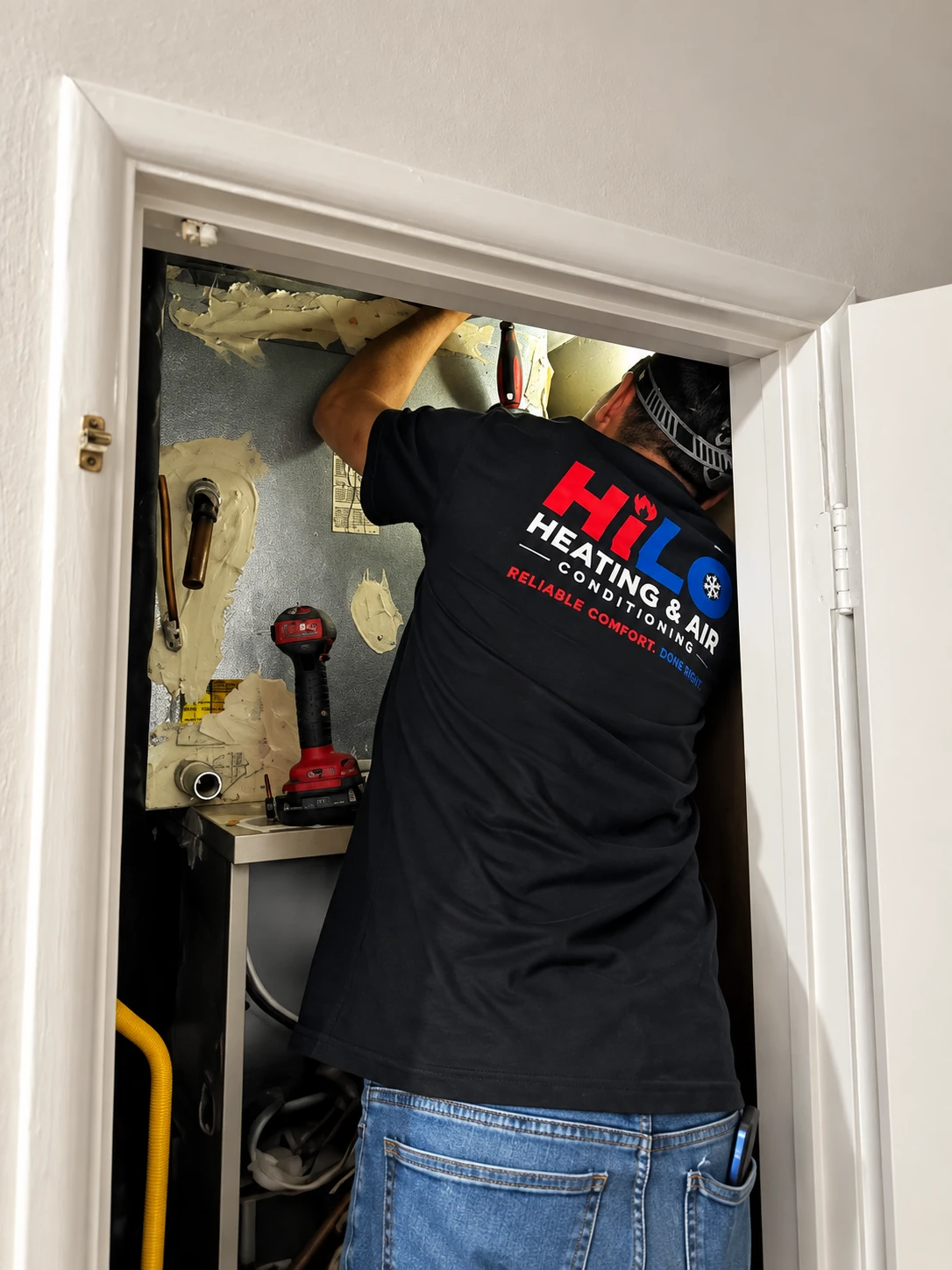
Cody
Verified TechnicianLead HVAC Technician & Content Lead
Cody is a lead technician at HiLo Heating & Air with over a decade of hands-on experience repairing, installing, and maintaining HVAC systems across Orange County. He holds EPA Section 608 certification and works under HiLo’s California C-20 contractor license (#1155955). Cody writes HiLo’s HVAC blog to help homeowners understand their systems, spot problems early, and make informed repair-versus-replace decisions.
Need help with this? HiLo can help.
Related services from HiLo Heating & Air:
Related Articles
Why Does My AC Smell? A Guide for Orange County Homes
Musty, burning, chemical, or rotten egg? Match the AC smell to its real cause, learn which ones mean shut it off now, and see what repairs cost in OC.
Read article
Heat Pump vs. Furnace: Which Fits Your Orange County Home?
Heat pumps fit Orange County's mild winters, but panel size, ducts, and 2026 electric rates decide it. A local guide to choosing heat for your home.
Read article
Heater Blowing Cold Air? A Technician's Diagnostic Guide
Heater blowing cold air? Learn whether your system is failing to make heat or failing to deliver it, plus the quick checks an Orange County tech runs.
Read articleNeed HVAC Help?
Call HiLo Heating and Air today for expert service. Explore our services or find your city.
(714) 853-5534