
How Long Does an AC Last in Orange County? 12 to 15 Years
Written by Cody
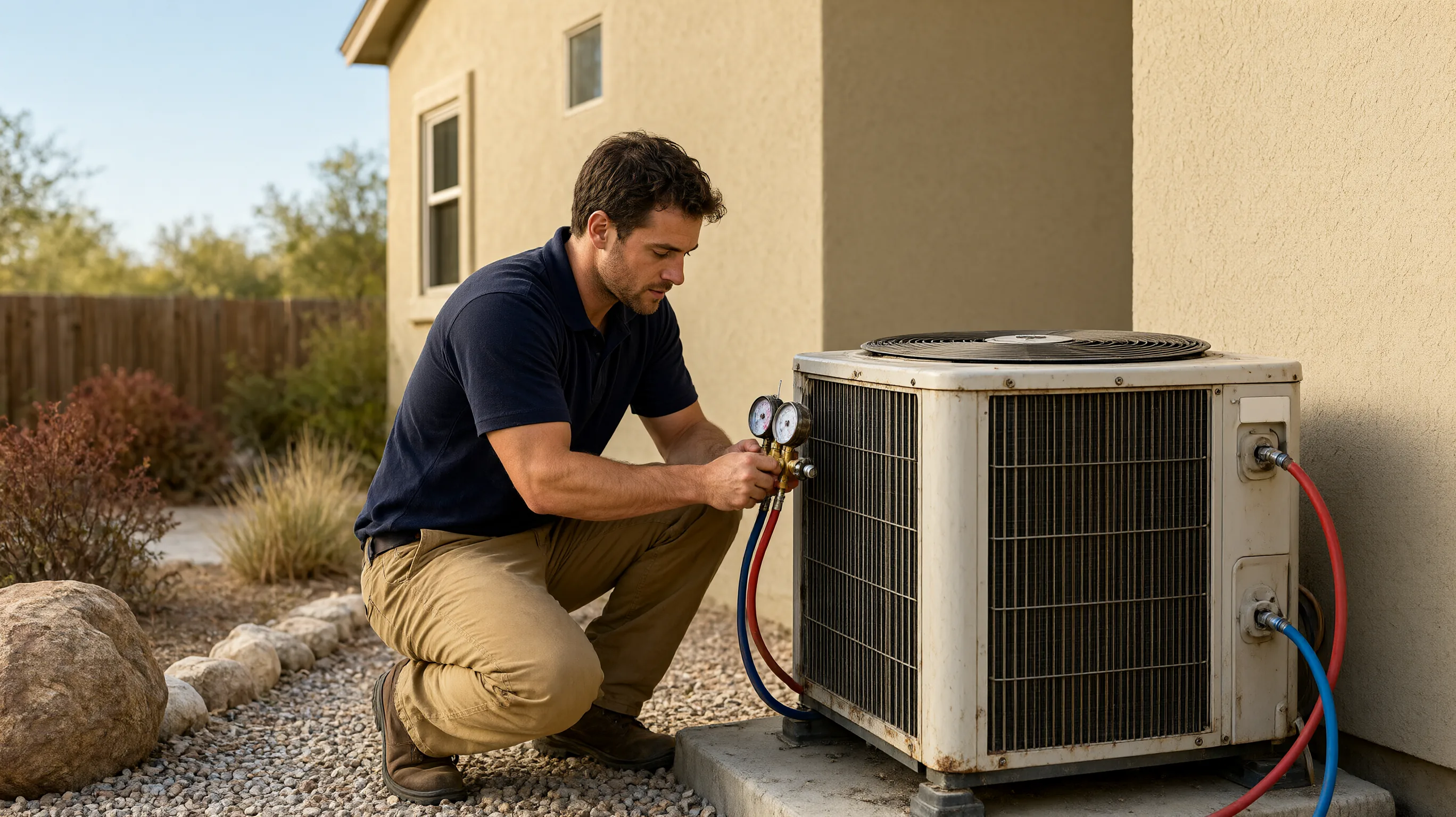
Quick answer: A central air conditioner in Orange County usually lasts 12 to 15 years. Long inland run hours and coastal salt air pull units toward the low end. The 15-to-20-year figure you also see quoted describes new equipment, not the average unit sitting in a backyard.
Every June, someone calls with the same question. The unit is 13 years old, it still cools, and a neighbor just replaced theirs. Is this one on borrowed time, or would replacing it now waste money on a machine with years left?
Age alone won’t answer that. Run hours, installation quality, refrigerant, and the last repair matter more.
Why the number online doesn’t match the one in your yard
Search the question and you get 15 to 20 years. Ask a technician who works here and you hear 12 to 15. Both are defensible, because they answer different questions.
| Source | Figure | What it actually describes |
|---|---|---|
| HomeGuide, AC repair cost guide, Aug 22, 2025 | 12 to 15 years | Average for units already in service, “if properly maintained” |
| HomeGuide, AC replacement guide, July 25, 2025 | 15 to 20 years | Expectation for a new system, not a measured life |
| ENERGY STAR, “When is it time to replace?”, accessed Nov 2, 2026 | “More than 10 years old” | A prompt to get the system evaluated, not a failure date |
The repair guide counts equipment already in service and lands at 12 to 15. The replacement guide describes equipment sold today and projects 15 to 20, assuming it gets sized and maintained correctly. Neither is wrong, but the second is a forecast made at install, and forecasts cannot account for neglected units. The same guide lists “more than 10 to 12 years old” as a replacement trigger a few lines after quoting 15 to 20.
Expect 12 to 15 from an existing Orange County house. The top of the range is real. It isn’t the middle.
What shortens an AC’s life in Orange County
These are mechanisms, not predictions about your house.
A cooling season that starts in May and ends in October
Run hours are the closest thing a sealed system has to a mileage counter. An inland house in Anaheim or Santa Ana runs its compressor roughly eight months a year. A house a few miles from the water runs four or five. Same calendar age, very different odometer. Irvine sits between the two.
That is why a 15-year-old coastal unit can look better on paper than a 12-year-old unit from the valley. The calendar lies a little.
Salt air attacks the part that sheds heat
Marine air carries chloride. On a condenser in Huntington Beach or Newport Beach, it shows up as pitted aluminum fins, rusted cabinet screws, and corrosion at the fan motor shaft. The coil stops rejecting heat efficiently, so the compressor runs at higher head pressure to do the same job. Not a dramatic failure, just a unit working harder each summer.
Attics and closets are hostile rooms
An air handler in a summer attic runs hotter than the manufacturer intended, which shortens motor winding life and cracks drain pans. A closet install has the opposite problem: too little return air, so the blower pulls against a closed door.
Oversized systems short cycle
An oversized unit blasts the house to setpoint in minutes and shuts off. That feels efficient. It isn’t. Short cycles never let the coil dehumidify, and every start loads the compressor harder than steady running does.
Restricted returns and thick filters
Many older Orange County tract homes have one central return, often a single 20 by 20 grille. Add a thick filter and a few closed doors and the system breathes through a straw. Static pressure climbs, airflow drops, and the evaporator coil can freeze. ENERGY STAR notes that a typical duct system loses 20 to 30 percent of its air to leaks. Duct sealing often does more for airflow than a bigger unit would.
Deferred maintenance and dirty coils
A dirty condenser coil is insulation wrapped around the part that should shed heat. ENERGY STAR’s maintenance checklist says dirty coils make the system run longer, raise energy costs, and reduce equipment life. It also warns that a dirty filter can cause early failure. Neither is dramatic. Both compound.
Surges and bad power
Capacitors and control boards are vulnerable to surges. Grid switching, a restart after an outage, or a nearby strike can take out a cheap part. A dedicated surge device costs less than the board it protects.
How to read the age of your own unit
Photograph the data plate before you call anyone. It is usually a silver sticker on the side of the outdoor unit or behind the service panel. Get the model, serial, refrigerant, and build date in one photo. The model number gives tonnage and series, and the refrigerant tells you whether you have R-22, R-410A, or an A2L blend.
The serial usually encodes the date
Most manufacturers build a date into the serial: first four digits for week and year, or a letter for the month and a digit for the year. Carrier, Trane, Lennox, and Rheem have used different formats, so send the serial to the manufacturer rather than trusting a forum post.
The install date matters more than the build date
A unit built in 2019 and installed in 2021 has two fewer years of service than its build date suggests. Inspection reports often estimate age from the data plate and can be off by years. A permit record or the original invoice is better evidence. Check whether only the outdoor unit was replaced. A newer condenser paired with an older indoor coil behaves like the older half.
What fails first, and what a year-12 repair tells you
There is no standard published failure-rate table for residential AC parts, so read this as the order wear tends to show up, not a schedule.
| Component | Typical sign | What it means at year 12 |
|---|---|---|
| Run capacitor | Unit hums, won’t start, fan spins slowly | Normal wear. Replace and move on. |
| Contactor | Clicking, compressor won’t engage | Normal wear. Often replaced with the capacitor. |
| Condenser fan motor | Fan slow or stopped, top of unit hot | Bearing wear or corrosion. Mid-priced repair. |
| Blower motor | Weak airflow, noise from the air handler | Attic heat shortens life. Can be a bigger job. |
| Compressor | Breaker trips, no cooling, loud hum | The expensive one. Decide carefully. |
| Evaporator coil | Frozen coil, refrigerant loss, water | A leak here often ends an R-22 system. |
A repair at year 12 is information, not a verdict. A capacitor or contactor would have failed on a three-year-old unit too. A compressor is the one that forces the decision.
HomeGuide puts an out-of-warranty compressor at $1,800 to $2,800 and a straight AC replacement at $5,000 to $8,300 (Aug 22 and July 25, 2025). Run those numbers. $2,800 is about 34 percent of an $8,300 changeout and 56 percent of a $5,000 entry-level one. So the same repair is a third of the bill or more than half, depending on which replacement you would actually buy. An out-of-warranty evaporator coil runs $2,500 to $4,500 on the same page, which can pass half the price of a $5,000 system by itself.
If the unit is down right now, start with AC repair. You can always replace later. You cannot un-spend an emergency install premium.
Repair or replace: five questions instead of a slogan
You have probably met the rule that multiplies repair cost by age and compares the answer to $5,000. HomeGuide publishes it alongside the 50 percent line, and it still scraps a 9-year-old system over a $600 repair. No code requires it. Use five questions instead.
| Factor | Question | Lean repair | Lean replace |
|---|---|---|---|
| Age | Past 12, or past 15? | Under 10 | 15 or older |
| Repair cost | More than half of a new system? | Under 30 percent | Over 50 percent |
| Refrigerant | Is it R-22? | R-410A or A2L | R-22 with a coil leak |
| Efficiency | Have bills climbed for three summers? | Stable bills | Climbing bills, old unit |
| Tenure | Still in the house in five years? | Moving soon | Staying put |
Between 30 and 50 percent, the other four questions decide.
The 50 percent line comes from HomeGuide, which lists a repair costing at least half of a new AC as a replacement trigger (Aug 22, 2025). It is a guideline, not a law. A $2,600 repair on a 13-year-old unit you plan to leave in two years is a bad bet. The same repair on a 9-year-old unit you just bought might be reasonable.
For the full local price picture, including ductwork and permits, see our HVAC replacement cost guide.
An air conditioning installation quote should include a Manual J load calculation, a matched indoor coil, and a line set inspection. A contractor who quotes the old tonnage without measuring the house is selling you the same mistakes.
What actually extends life, and what doesn’t
What works
- Filters. Check monthly and change when loaded. A one-inch filter loads faster than a four-inch media filter, and pets or a dusty street push it further.
- Coil cleaning. Rinse the condenser coil at least yearly near the coast. Work from the inside out and don’t bend the fins.
- Clearance. Keep the area clear to the clearance printed on the label. Shade is fine if it doesn’t block airflow. A unit behind a solid fence recirculates its own hot air.
- Annual service. Not a filter swap. A real AC maintenance visit measures capacitor microfarads, amp draw, superheat and subcool, static pressure, and coil condition, then writes the readings down.
What doesn’t
- “Set it colder to cool faster.” A thermostat is a switch, not a throttle. A single-speed system, still common here, runs at one speed whether you set 72 or 62. It just runs longer and overshoots.
- “Bigger is better.” An oversized unit short cycles, dehumidifies poorly, and wears the compressor harder.
- “Top it off every spring.” Refrigerant is a sealed system. If it is low, it is leaking. Topping it off without finding the leak is a subscription, not a repair.
- “Leave the fan on.” A fan in the ON position pulls moisture back off the wet coil. AUTO is the better default here.
The refrigerant question, in three sentences
R-22 has not been produced or imported in the United States since January 1, 2020, so any charge left is reclaimed (EPA, updated April 1, 2026). New equipment built for this market since January 1, 2025 has to stay under a global warming potential limit of 700, which in practice means an A2L refrigerant such as R-454B or R-32. Systems whose components were all built or imported before January 1, 2025 can still be installed, because EPA’s final rule published May 26, 2026 removed the January 1, 2026 deadline (Federal Register, 91 FR 31284, effective July 27, 2026).
If your unit is 12 or older and still running, do this this month
Don’t replace a working unit because of a birthday. Do get it assessed before the next heat wave, when every contractor is booked.
- Photograph the data plate. Write down the serial, refrigerant, and install date.
- Pay for a measured inspection, not a free sales visit. Ask for the readings in writing.
- Clean the condenser coil and change the filter. Cheapest hour of life you can buy.
- Fix the small stuff now. A weak capacitor or a cracked drain pan becomes a July failure.
- Get a replacement quote while the unit still works. Compare numbers without pressure.
- Set a decision trigger now. If a repair crosses the number you name, you replace. If it fails in July, you already know your answer.
What HiLo checks at end of life
We are family owned, in business since 2016, working out of 8131 Electric Ave in Stanton, CA 90680. We serve Orange County and Los Angeles and hold California C-20 license #1155955. When a unit is near the end, we start with measurements, not a replacement pitch.
Our end-of-life inspection covers serial and age, refrigerant type, compressor amp draw and winding resistance, capacitor values, contactor pitting, coil corrosion, refrigerant pressures and leak evidence, static pressure and temperature split, the drain pan and float switch, and duct capacity.
If the numbers say repair, we say so. If the next failure is a compressor, we tell you that too, and we put the replacement scope in writing: line set, pad, disconnect, permit, load calculation, and a matched coil. If replacement is the answer, our HVAC replacement service handles the whole job. Call (714) 853-5534 or contact us to schedule an assessment.
FAQ
How long does an AC last in Orange County?
Plan on 12 to 15 years. Long inland run hours and coastal salt air both pull units toward the low end. A well-kept coastal unit with annual coil rinsing can reach the top of the range; an inland unit running eight months a year more often lands at 12.
Is a 15-year-old AC too old?
Not automatically. A unit that cools well, runs quiet, and has never needed refrigerant can still have years left. A leaking coil or a compressor drawing high amps is a different story.
Should I replace my AC before it breaks?
If it is 12 or older and you plan to stay, get a quote before failure. You avoid emergency pricing and July availability.
How can I tell how old my AC is?
Check the data plate for the serial, then use the manufacturer’s lookup or call them. The permit or invoice date matters more than the build date.
Does salt air really shorten AC life near the beach?
It can. Chloride in marine air corrodes aluminum fins, steel fasteners, and fan motor shafts. A coastal condenser needs annual coil rinsing and a closer eye on the fan motor.
Is it worth repairing a 12-year-old AC?
It depends on the repair. A capacitor, contactor, or fan motor is normal wear and worth fixing. A compressor or evaporator coil on an R-22 system usually is not.
Can I still install an R-410A system in 2026?
Yes, while stock lasts. The May 2026 rule removed the installation deadline for equipment manufactured or imported before January 1, 2025, so distributors can still sell and install that inventory. No new R-410A equipment is being made for this market.
Cody
Verified TechnicianLead HVAC Technician & Content Lead
Cody is a lead technician at HiLo Heating & Air with over a decade of hands-on experience repairing, installing, and maintaining HVAC systems across Orange County. He holds EPA Section 608 certification and works under HiLo’s California C-20 contractor license (#1155955). Cody writes HiLo’s HVAC blog to help homeowners understand their systems, spot problems early, and make informed repair-versus-replace decisions.
Need help with this? HiLo can help.
Related services from HiLo Heating & Air:
Related Articles
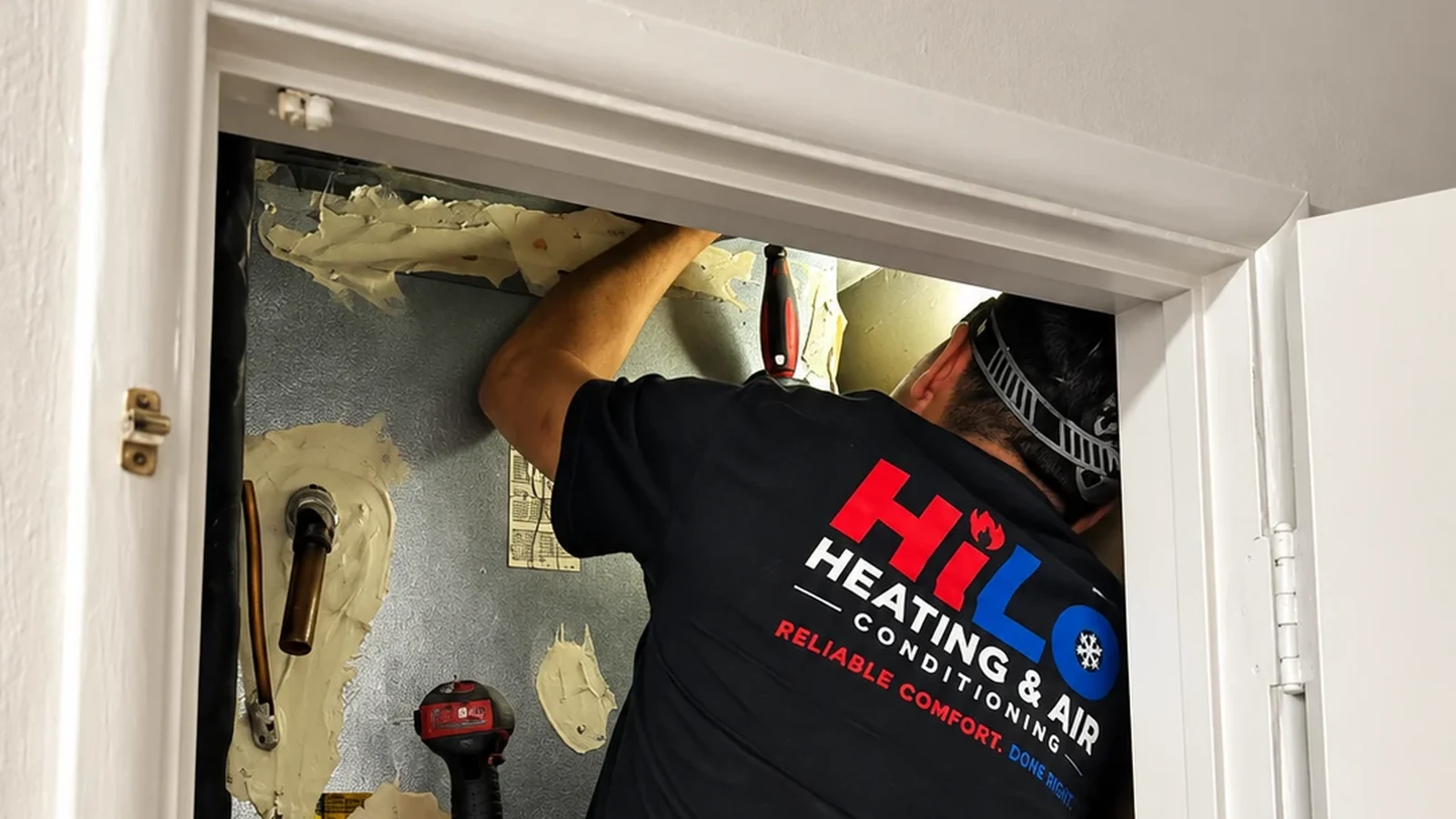
AC Leaking Water? Why It Happens in Orange County Homes
Water at the air handler, a ceiling stain, or a drip outside? How Orange County homeowners can find the real cause, stay safe, and stop the damage.
Read article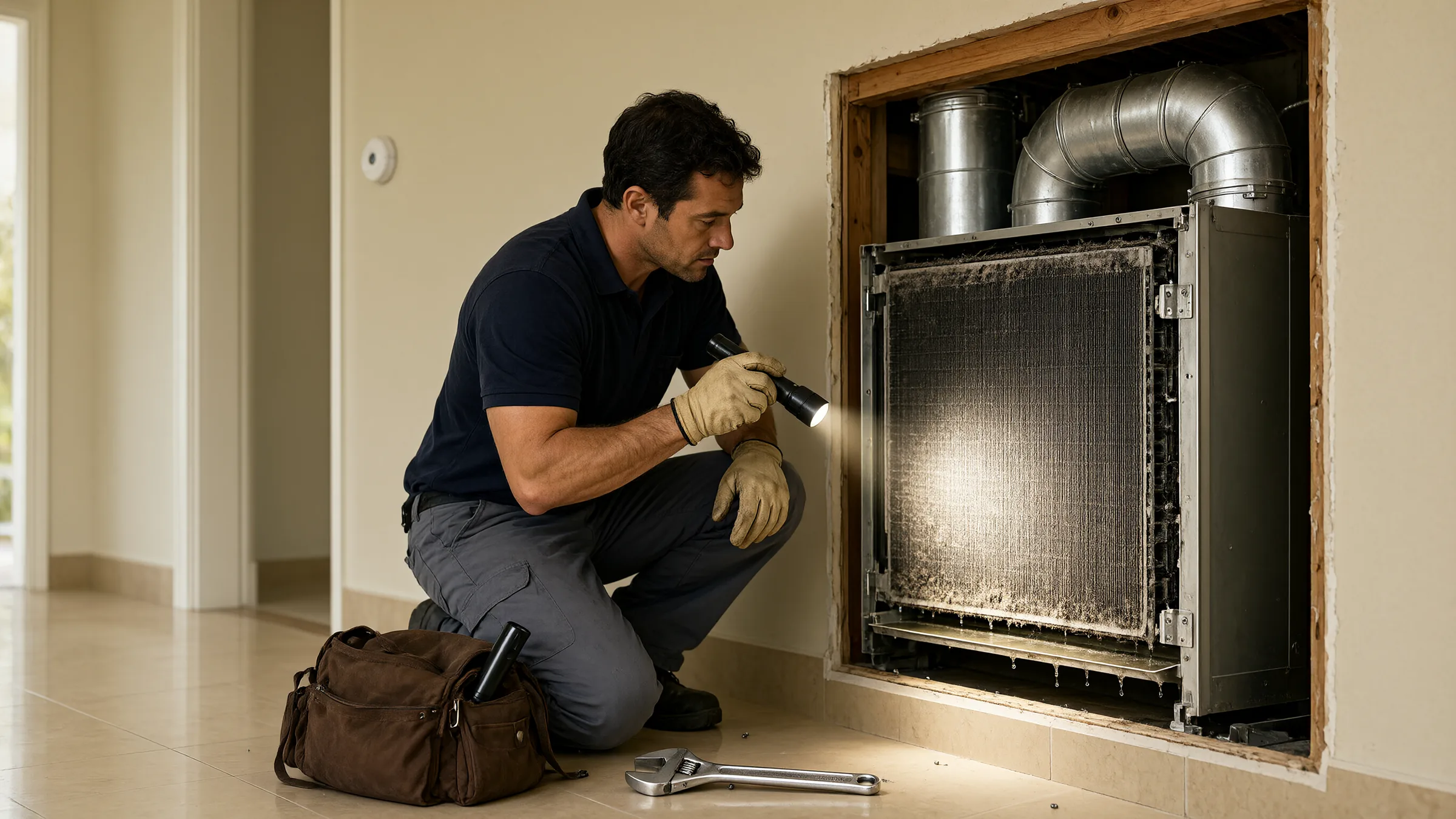
Why Does My AC Smell? A Guide for Orange County Homes
Musty, burning, chemical, or rotten egg? Match the AC smell to its real cause, learn which ones mean shut it off now, and see what repairs cost in OC.
Read article
AC Repair Anaheim: Warning Signs, Common Failures, and Smart Decisions for Homeowners
AC repair in Anaheim — learn the warning signs, common failures, simple pre-call checks, and how to choose a qualified HVAC technician in Orange County.
Read articleNeed HVAC Help?
Call HiLo Heating and Air today for expert service. Explore our services or find your city.
(714) 853-5534