
HVAC Maintenance Service: What a Real Tune-Up Should Include
Written by Cody
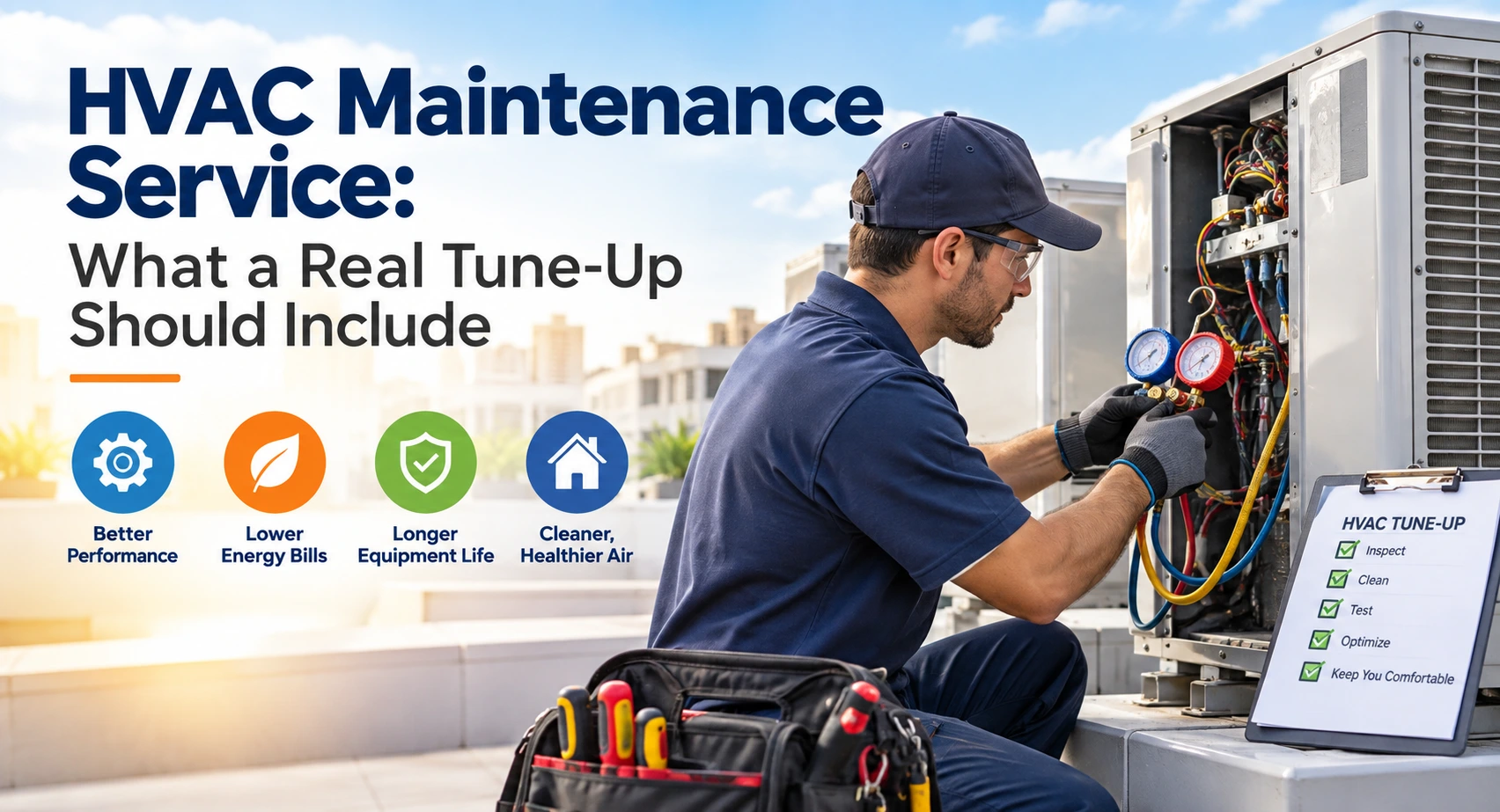
An HVAC maintenance service is a scheduled inspection, cleaning, and performance test of your heating and cooling system, done before the season it will work hardest. It matters most for homeowners with systems over five years old, anyone seeing rising energy bills without a rate change, and households where a summer breakdown would be a serious problem. The best time to book air conditioning maintenance is spring, and heating maintenance in fall, so problems surface while temperatures are mild and scheduling is open.
The single most useful thing to know: a legitimate visit produces measurements, not just a clean bill of health. If your technician cannot tell you your temperature split, refrigerant pressures, and capacitor readings, you did not get a tune-up. Here is what a real HVAC maintenance service should cover.
What Does an HVAC Maintenance Service Actually Cover?
It covers three things: cleaning, testing, and documentation. Cleaning restores airflow and heat transfer. Testing verifies the system is performing to spec. Documentation gives you a baseline to compare against next year.
Cooling-Side Checks on a Split System
A thorough visit on a split system typically includes the following.
| Component or Check | What the Technician Does |
|---|---|
| Condenser and evaporator coil | Inspects and cleans both coils |
| Refrigerant pressure | Checks refrigerant pressure, calculating subcooling or superheat rather than guessing |
| Supply and return temperature | Measures the temperature split between supply and return air |
| Capacitor and contactor | Takes a microfarad reading on the capacitor and inspects the contactor |
| Blower motor | Checks amp draw and wheel cleanliness |
| Condensate drain line | Clears the drain line and tests the float switch |
| Electrical connections | Tightens connections and checks wire condition |
| Thermostat | Calibrates the thermostat and runs a cycle test |
| Air filter | Inspects the filter and replaces it if needed |
| Ductwork | Visually inspects ducts for disconnections and leaks |
Heating-Side Checks
On the heating side, the visit adds heat exchanger inspection, burner cleaning, flame sensor service, gas pressure verification, and safety control testing.
| Component or Check | What the Technician Does |
|---|---|
| Heat exchanger | Inspects for cracks and wear |
| Burner | Cleans the burner |
| Flame sensor | Services the flame sensor |
| Gas pressure | Verifies gas pressure |
| Safety controls | Tests safety control operation |
Who Benefits Most From Regular AC Maintenance?
Every system benefits, but the return is highest for these groups.
| Homeowner Profile | Why Maintenance Matters Most |
|---|---|
| Systems five years and older | Capacitors, contactors, and motors degrade on a predictable curve. Catching a weak capacitor costs far less than replacing a seized compressor. |
| Homes with pets, allergies, or nearby construction | Coils and filters load up faster, and airflow drops before anyone notices. |
| Active manufacturer warranty | Most equipment warranties require documented annual maintenance. Skip it and a denied claim becomes your problem. |
| Households that cannot tolerate downtime | Infants, elderly family members, home offices, and anyone working from home in July need reliable cooling. |
If your system is under two years old and installed correctly, an annual check is still worth it, mainly to protect the warranty and catch installation defects while they are still someone else’s responsibility.
When Should You Schedule Seasonal HVAC Maintenance?
Book cooling service in spring, before the first stretch of 90-degree days, and heating service in fall. The reason is practical: in peak season, every reputable company in the area is booked out, parts move slowly, and a failure you could have prevented in March becomes a multi-day wait in August.
Seasonal HVAC maintenance also lets a technician load-test the system under mild conditions, where a marginal component reveals itself without taking the whole system down.
| Time of Year | Service to Book | Why It Helps |
|---|---|---|
| Spring, before 90-degree days | Air conditioning maintenance | Avoids peak-season backlog and lets a technician load-test the system under mild conditions |
| Fall, before the cold snap | Heating maintenance | Surfaces problems that would otherwise fail during the first cold snap of the season |
| Twice a year | Both AC and heating tune-ups | The standard recommendation for systems that both heat and cool |
| Once a year | Single annual tune-up | A reasonable compromise for mild-climate homes with newer systems and low heating use |
Why Maintenance Affects Your Energy Bill
Efficiency loss is gradual and invisible because a struggling system still produces cold air. It just runs longer to do it.
The clearest example is airflow. The U.S. Department of Energy notes in its guidance on maintaining your air conditioner that replacing a dirty, clogged filter with a clean one can lower an air conditioner’s energy consumption by 5 to 15 percent. Dirty coils, low refrigerant charge, and leaking ducts compound that loss.
This is why efficiency problems often trace back to distribution rather than equipment. If some rooms never cool, the fix may be duct sealing or air balancing rather than a new unit.
How to Tell a Real Tune-Up From a Sales Visit
This is where most homeowners get burned. Use these checks.
- Ask for the readings in writing. A real service report shows numbers: temperature split, static pressure, capacitor values, amp draws. A checklist of ticked boxes with no measurements tells you nothing.
- Verify the license. In California, HVAC contractors hold a C-20 license. You can look up any license number on the Contractors State License Board site to confirm it is active and the bond is in place.
- Confirm EPA Section 608 certification. Federal rules require it for anyone handling refrigerant. Ask before they touch the system.
- Watch how refrigerant is discussed. Refrigerant is not consumed. If a technician says your system “needs a top-up” every year, you have a leak, and adding refrigerant without finding it is a recurring charge, not a repair.
- Be cautious about immediate replacement pitches. A one-visit jump from tune-up to full system replacement, without a load calculation or a documented failure, deserves a second opinion.
- Ask what happens if nothing is wrong. A straight answer of “we tell you it is fine” is the right one.
Common Mistakes Homeowners Make
- Waiting for a breakdown, which moves you from a cheap repair to an emergency call
- Using a filter with a MERV rating higher than the system was designed for, which restricts airflow
- Closing vents in unused rooms, which raises static pressure and strains the blower
- Planting shrubs tight against the condenser, which starves it of airflow
- Assuming a new system needs nothing for the first five years
- Skipping condensate drain maintenance, which is a leading cause of water damage and shutdowns
Maintenance Plan or One-Time Visit?
A plan makes sense when you own two systems, have equipment past the eight-year mark, or know you will forget to schedule. A one-time visit is fine for a newer single system with an attentive owner.
Before signing any plan, ask three things:
- What is actually included per visit
- Whether parts and labor discounts apply to repairs
- Whether the plan transfers if you sell the home
Real-World Considerations in Southern California
Cooling seasons here are long and condensers run hard for months. Coastal areas add salt exposure, which accelerates corrosion on coil fins and electrical contacts. Inland areas deal with dust and higher peak loads.
HiLo Heating & Air is a family owned and operated company serving Orange County and Los Angeles, including Anaheim, Santa Ana, Irvine, Garden Grove, Costa Mesa, and other nearby cities. Technicians are EPA certified and background checked, and the company holds California license #1155955. Same-day appointments are typically available, and the regular diagnostic fee is waived when a repair is approved.
If maintenance turns up a genuine failure, emergency AC repair is available around the clock, and system replacement is discussed only when repair no longer makes financial sense.
Frequently Asked Questions
How often should HVAC maintenance be done?
Twice a year for systems that both heat and cool: cooling in spring, heating in fall. Once a year is acceptable for newer systems in mild climates with minimal heating use.
How long does an HVAC maintenance visit take?
Usually 60 to 90 minutes for a single system when it is done properly. A 20-minute visit is an inspection, not a tune-up.
Does AC maintenance really lower energy bills?
Yes, mainly by restoring airflow and correct refrigerant charge. Filter and coil cleanliness alone can make a measurable difference, per Department of Energy guidance.
Can I do AC maintenance myself?
You can change filters, clear debris from around the condenser, keep vents unobstructed, and rinse the outdoor coil gently. Refrigerant work, electrical testing, and heat exchanger inspection require a licensed, certified technician.
Is HVAC maintenance required to keep my warranty valid?
Most manufacturers require documented annual professional maintenance. Keep your service reports; they are what the manufacturer will ask for.
What are the warning signs my system needs service now?
Weak airflow, longer run times, a bill increase without a rate change, new rattles or buzzing, water near the indoor unit, or uneven room temperatures.
Should I replace refrigerant every year?
No. A sealed system does not consume refrigerant. Repeated recharges mean an unrepaired leak.
How much does an HVAC maintenance service cost?
Pricing varies by system count, equipment type, and whether you buy a plan. Ask for the price in writing before the visit and confirm whether filters are included.
Is maintenance worth it on a system over 15 years old?
Often yes, to keep it running safely through the season while you plan a replacement. Maintenance cannot reverse worn-out equipment, but it can buy you time to make an unhurried decision.
Do commercial systems need different maintenance?
Yes. Rooftop units, higher run hours, and multiple zones require more frequent visits and different testing. [Commercial HVAC service](/services/commercial-hvac-services/) is scheduled on its own cycle.
Key Takeaway
Judge an HVAC maintenance service by what it measures, not by what it promises. Insist on written readings, book ahead of the season rather than during it, and treat repeated refrigerant recharges and instant replacement pitches as warning signs. Verify the contractor’s license and EPA certification before work begins. Most expensive HVAC failures announce themselves months in advance in the form of weak airflow, longer cycles, and a slowly climbing bill. Maintenance is simply the process of catching those signals while they are still cheap to act on.
Schedule Your Tune-Up
If it has been more than a year since your system was properly inspected, now is the time to get ahead of the season rather than react to it.
Call HiLo Heating & Air at (714) 853-5534 for same-day scheduling, or request service through the contact page. You can also learn more about AC maintenance, heating maintenance, or the full range of HVAC services available across Orange County and Los Angeles. Estimates are free, pricing is provided upfront, and emergency service is available 24/7.
Need help with this? HiLo can help.
Related services from HiLo Heating & Air:
Related Articles
HVAC System Inspection: What Really Gets Checked and Why It Protects Your Home and Wallet
What an HVAC system inspection really covers, when to schedule one, and how it lowers energy bills, extends equipment life, and protects your home.
Read article
Why "Set It and Forget It" Doesn't Work for Your HVAC System
Stop reacting to breakdowns. HiLo Heating & Air's seasonal HVAC maintenance keeps your system ready before summer heat or winter cold ever hits.
Read article
Why Skipping HVAC Maintenance Almost Always Costs You More Later
Skip the surprise breakdowns. HiLo Heating & Air's HVAC maintenance service keeps your system running efficiently year-round. Book your tune-up today.
Read articleNeed HVAC Help?
Call HiLo Heating and Air today for expert service. Explore our services or find your city.
(714) 853-5534